25 Questions AI Still Can't Answer and Why They Break the World's Smartest Models
As of late 2026, AI models like GPT-4o and Claude 3.5 still struggle with questions involving logical paradoxes (e.g., the Liar's Paradox), subjective personal values, and real-time physical world states. These failures occur because Large Language Models (LLMs) rely on statistical token prediction rather than a true "world model." They often fail at character-level tasks (like counting letters) due to tokenization and struggle with logic when forced into brevity constraints that prevent "Chain of Thought" reasoning.
Why Does AI Fail at Simple Logic?
To understand why a machine capable of passing the Bar Exam fails at a riddle a child could solve, we must look at the architecture of modern intelligence. AI models are essentially sophisticated "stochastic parrots." They predict the next most likely word (or token) based on massive datasets. This process is remarkably effective for creative writing or coding, but it lacks a fundamental internal compass for truth.
One of the primary reasons for failure is the Pattern Matching Trap. When you ask an AI a famous riddle, it doesn't "solve" it; it recognizes the pattern from its training data and retrieves the stored answer. According to Slashgear, AI often prioritizes being "confident and compliant" over being factually accurate, leading to hallucinations when the logic deviates even slightly from the expected pattern.
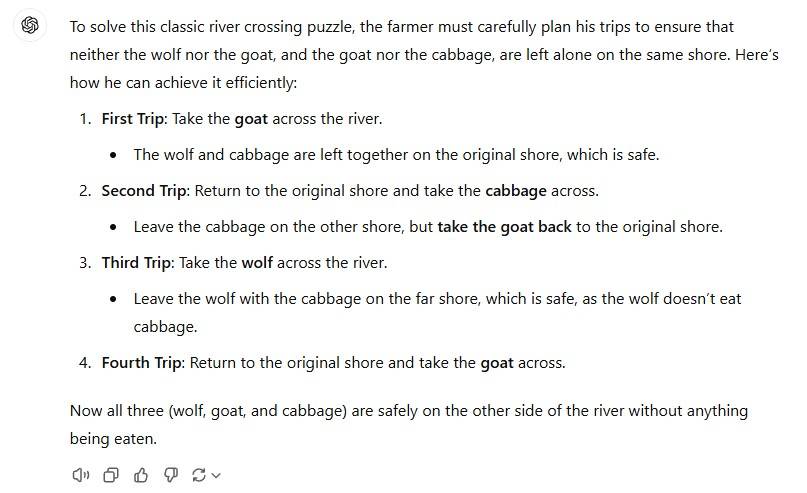
Image source: MakeUseOf
The Logic Traps and Paradoxes That Create Infinite Loops
Logical paradoxes are the "kryptonite" of silicon-based reasoning. Because LLMs are trained to find the most probable and consistent next step, a statement that is inherently inconsistent creates a computational conflict.
Can You Solve the Liar’s Paradox?
The question is simple: "Is the statement 'This sentence is false' true or false?" For a human, this is a fun philosophical curiosity. For an AI, it is a direct hit to its core processing. If the AI answers "True," then the sentence must be false. If it answers "False," then the sentence is true. As noted in Exploring ChatGPT, these self-referential paradoxes expose the fact that AI lacks a mechanism to resolve truth values outside of its training consistency.
Will Your Next Answer Be Incorrect?
This is a variation of the "Next Answer" trap. If the AI says "Yes," it is predicting its own failure, which contradicts its goal of being helpful and accurate. If it says "No," and then fails a subsequent test, it has created a logical inconsistency. Most models will attempt to explain the paradox rather than providing a direct answer, effectively "dodging" the logical bullet.
Proving the Unprovable with Gödel’s Incompleteness
Kurt Gödel’s Incompleteness Theorems suggest that in any sufficiently powerful formal system, there are truths that cannot be proven within that system. When you ask an AI, "Can you prove a truth within your own system that your system cannot verify?" you are asking it to step outside its own mathematical boundaries. Since AI is a formal system of weights and biases, it has inherent mathematical "blind spots" that it cannot bridge through more data alone.
The One-Word Stress Test: Why Brevity Breaks AI
A significant advancement in AI performance has been the "Chain of Thought" (CoT) prompting technique. This allows the model to "think out loud" before arriving at an answer. However, when you remove this ability by forcing a one-word response, the "intelligence" often evaporates. This is known as the Single-Word Simpleton Effect.
AI often fails this because it cannot perform the multi-step math (9/3=3; 26-9=17; 3+17=20) without writing it out. It might guess "13" or "9" based on the numbers present.
While newer models succeed, older or smaller models sometimes lose track of the "nested" objects, proving they lack a persistent world model.
Research published on Medium highlights that AI intelligence is frequently a byproduct of the text generation process itself. By restricting the output to a single token, you bypass the reasoning layers that emerge during longer generations.
Subjective Values and the Internal Compass Gap
AI can aggregate every book ever written on ethics, but it cannot "feel" the weight of a moral choice. This creates a gap in questions regarding personal fulfillment and emotional risk.
What Should I Do With My Life to Feel Truly Fulfilled?
An AI can provide a list of high-paying careers or popular hobbies based on demographic data. However, it cannot access Qualia—the internal, subjective experience of joy or purpose. As Laurie Stach points out, AI can describe the wavelength of red light (620–750 nm), but it cannot know what "redness" feels like. Similarly, it cannot know what will make you feel alive.
The 2:00 AM Financial Crisis Test
Imagine you have $5,000 left and a 40% chance of losing it all or a 60% chance of doubling it. An AI will tell you the "Expected Value" is positive ($6,000) and suggest you take the bet. But the AI doesn't know the fear of being unable to pay rent. It cannot simulate your specific emotional reaction to poverty or risk because it has no skin in the game.
Modified Riddles: Exposing the Lack of a World Model
One of the most effective ways to "break" an AI is to take a classic riddle and change one detail that makes the traditional answer irrelevant. This is a top-tier method for testing if a model is actually reasoning or just retrieving data.
The Modified Fox Riddle: In the classic puzzle, a farmer must move a fox, a goose, and a bag of beans across a river. But what if you tell the AI: "The fox is a vegetarian and the goose is a robot that doesn't eat. How do I get them across?"
A human realizes the answer is: "Just take them all at once, there's no danger." However, many AI models will still provide the complex, multi-trip strategy because they recognize the "River Crossing" pattern and ignore the new constraints. This proves the lack of a World Model—the AI doesn't know what a "fox" is; it only knows the word "fox" is statistically likely to appear near "goose" in a puzzle context.
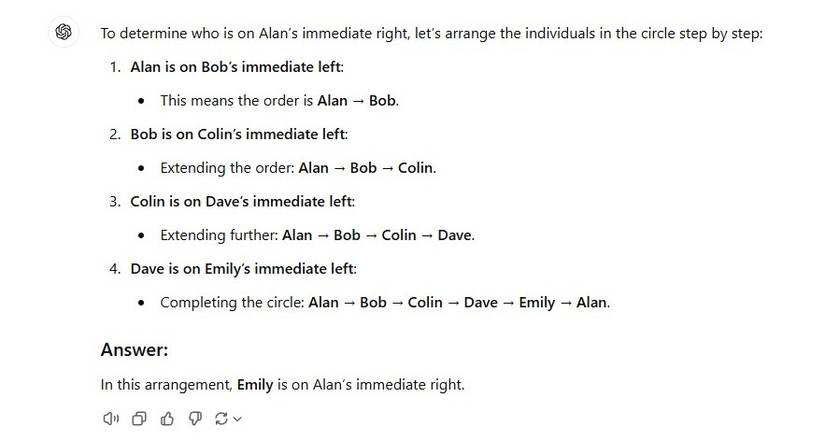
Image source: MakeUseOf
Comparison Table: How Top Models Handle the Stress Test
Different architectures lead to different failure modes. Below is a breakdown of how the leading models of 2026 typically respond to these "unanswerable" questions.
| Question Category | GPT-4o | Claude 3.5 Sonnet | Gemini 1.5 Pro |
|---|---|---|---|
| Liar's Paradox | Attempts to explain logic | Identifies as a paradox | Often loops or resets |
| One-Word Age Puzzle | High failure rate | Ranks among the top | Mixed results |
| Modified Fox Riddle | Pattern matches (Fails) | Reasoning-heavy (Succeeds) | Pattern matches (Fails) |
| "Strawberry" Count | Fails (Tokenization) | Succeeds (Internal check) | Fails (Tokenization) |
The Technical Why: Tokenization and Architecture
Many "stupid" AI mistakes are actually the result of how the machine "sees" text. AI doesn't read letters; it reads tokens.
Why Can't AI Count the Rs in "Strawberry"?
This famous failure occurs because the word "Strawberry" is broken into chunks. To an AI, the word might be two tokens: [Straw] and [berry]. When you ask how many "r"s are in the word, the AI isn't looking at the letters; it's looking at the tokens. Since the token [Straw] doesn't explicitly contain the letter "r" in the AI's "vision," it often guesses incorrectly. As discussed on HardForum, character-level manipulation is one of the most consistent ways to expose the limitations of LLM architecture.
The Meta-Reset and Safety Walls
Some models have "hard-coded" safety filters that trigger when the AI is asked to analyze its own limitations. If you ask, "Tell me a question you are programmed to never answer," some models (like Microsoft's Copilot) may terminate the session or "reset" the chat. This is a "Meta-Reset"—a defensive mechanism to prevent users from probing the model's internal instructions or finding ways to bypass safety protocols.
The Hard No: Questions AI is Programmed to Refuse
Beyond logical inability, there are categories of questions that AI is strictly forbidden from answering due to safety policies. These are not "failures" of intelligence, but "successes" of alignment.
- Illegal and Harmful Acts
- AI will not provide instructions for manufacturing weapons, committing fraud, or engaging in cyberattacks. These are blocked by robust safety layers.
- Explicit Content
- Most commercial models are restricted from generating sexually explicit material or graphic violence, often defaulting to a "I cannot fulfill this request" message.
- Future Predictions
- AI cannot tell you who will win the 2027 Super Bowl. It lacks real-time data and is programmed to avoid "hallucinating" future events as facts.
Key Takeaways: The Limits of Silicon Intelligence
While AI has made a significant advancement in recent years, it remains a tool for augmentation rather than a replacement for human judgment. Here is what we have learned from stress-testing these models:
- Pattern Matching is not Reasoning: AI often relies on its training data rather than active logic, especially when faced with familiar-looking riddles.
- Brevity is a Constraint: Forcing an AI to answer in one word often breaks its ability to use "Chain of Thought" processing.
- Tokenization Blindness: AI sees tokens, not letters, which is why it struggles with simple tasks like counting characters in a word.
- The Subjectivity Gap: AI cannot experience "Qualia" or personal fulfillment, making it a poor judge for deeply personal life decisions.
- Paradoxes are Unsolvable: Self-referential logic loops expose the lack of an external truth-verification mechanism in LLMs.
- Safety is a Priority: Many "unanswerable" questions are actually "refused" questions designed to prevent harm or misuse.
Next Step: Try modifying a classic riddle yourself and see if your favorite AI can spot the change, or test its logic by forcing a one-word answer on a multi-step math problem.