In 2026, the distinction between AI and digital marketing has largely dissolved. Digital marketing remains the strategic discipline of connecting brands with audiences, while AI has evolved into the foundational engine that powers execution. For professionals, the choice isn't between one or the other, but rather how to integrate Agentic AI into traditional strategy. Those who master human-centric skills like empathy and high-level strategy while leveraging autonomous AI agents are currently commanding a 20-30% salary premium in the job market.
Understanding the Relationship Between AI and Digital Marketing
As we navigate the landscape of 2026, the debate of "AI vs Digital Marketing" is often framed as a competition. However, industry data suggests a more integrated reality. Digital marketing is the broad umbrella discipline encompassing all electronic promotion efforts, while AI serves as the intelligent engine driving modern optimization. According to Salesforce research, approximately 75% of marketing organizations now utilize at least one form of AI as a foundational component of their tech stack.
Defining the Modern Marketing Stack
The marketing stack has shifted from a collection of disparate tools to a unified, AI-first ecosystem. In the past, marketers used AI as a "feature"—a chatbot here, a basic recommendation engine there. Today, AI is the foundation. This means that every aspect of the digital marketing lifecycle, from audience segmentation to creative generation and media buying, is mediated by machine learning models. This evolution has moved AI from a subset of digital marketing to its primary operating system.
The Shift from Rules-Based to Intent-Based Systems
Traditional digital marketing relied heavily on rules-based logic: "If a user clicks X, show them Y." While effective for basic automation, it lacked the nuance of human behavior. AI marketing, by contrast, operates on intent-based logic. By analyzing vast datasets in real-time, AI can predict what a user wants before they even express it. This transition from retrospective analysis to predictive and generative execution is a significant advancement in how brands interact with consumers.
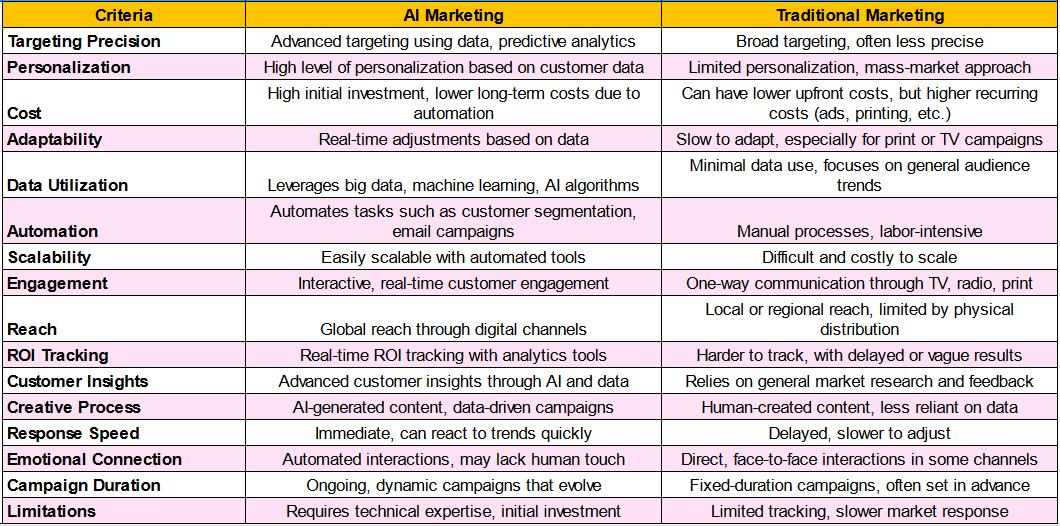
Image source: M1 Project
Addressing the Fear of Job Displacement in the Marketing Industry
The anxiety surrounding AI replacing human marketers is a frequent topic in professional communities. On platforms like Reddit's marketing forums, many entry-level professionals express concern that their roles are becoming obsolete. However, the consensus among experts is that AI is not replacing marketers; it is replacing marketers who refuse to adapt with those who embrace these new tools.
Why AI Targets Tasks Rather Than Entire Roles
AI excels at repetitive, data-heavy tasks. It can write 50 variations of a meta description in seconds or analyze thousands of A/B test results overnight. These are tasks, not roles. By automating these functions, AI allows human marketers to focus on high-level strategy, brand storytelling, and ethical oversight. As noted by Harvard Professional Development, AI acts as an efficiency driver that provides rapid feedback, enabling humans to iterate faster than ever before.
Navigating the Mediocre Content Trap
One of the most significant risks in the current market is the "mediocre content trap." Because AI has lowered the barrier to entry for content creation, the internet is being flooded with average, AI-generated blog posts and social updates. This ubiquity of "good enough" content has actually increased the value of high-quality human creativity. Marketers who can provide the "final 10%" of polish—adding unique perspectives, emotional resonance, and brand-specific nuance—stand out more than they did in the pre-AI era.
According to Salesforce data, AI integration can reduce campaign launch times from an average of 7.5 weeks to just a few hours. This represents an 80% improvement in time-to-market, shifting the human role from "creator" to "strategic editor."
The Rise of Agentic AI and Autonomous Campaign Management
The most notable innovation in 2026 is the shift from Predictive AI to Agentic AI. While predictive models forecast outcomes, agentic systems are autonomous agents capable of reasoning, planning, and executing multi-step workflows without constant human intervention. This is a significant step forward from simple automation.
Moving Beyond Predictive Analytics
In the early 2020s, marketers used AI to predict which customers might churn. In 2026, Agentic AI doesn't just predict churn; it identifies the at-risk customer, crafts a personalized retention offer, chooses the optimal delivery channel, and executes the campaign—all while monitoring the budget in real-time. These agents act as "digital employees" that handle the heavy lifting of campaign management, allowing human strategists to manage fleets of agents rather than individual tasks.
How Multimodal AI Enhances Multi-Channel Strategy
Modern AI is no longer limited to text. Multimodal models can process video, audio, and datasets simultaneously. This allows for cohesive multi-channel campaigns where the AI ensures that the visual style of a YouTube ad perfectly matches the tone of a LinkedIn post and the data-driven insights of an email campaign. This level of synchronization was previously impossible at scale for all but the largest enterprise brands.
Focus on pattern recognition, basic chatbots, and recommendation engines (Netflix/Amazon style).
Mass adoption of LLMs for copy, images, and basic video generation. AI as a "co-pilot."
Autonomous agents managing full campaign lifecycles. AI as an "autonomous executor" with human oversight.
Analyzing the B2B Self-Serve Paradox and High-Ticket Sales
A surprising trend in 2026 is the "B2B Self-Serve Paradox." For decades, the mantra was that "people buy from people," especially for high-ticket enterprise deals. However, data from community discussions and industry reports suggests a massive shift in buyer behavior. Many C-level executives now prefer efficient, AI-driven self-service over lengthy sales calls.
The $500,000 Threshold for Human-Free Transactions
Recent data indicates that 70% of B2B decision-makers are comfortable making self-serve purchases of $50,000 or more. Even more striking is that 27% of B2B buyers are now willing to spend $500,000+ without ever speaking to a human representative. This suggests that AI-driven funnels, which provide instant answers and frictionless checkout, are becoming a top-tier choice for enterprise procurement.
When the Human Touch Remains a Competitive Advantage
Despite the rise of autonomous B2B sales, the "human touch" has not lost its value—it has simply changed its application. For small, local businesses or highly sensitive industries (like crisis management or specialized legal services), human trust remains the primary USP. The paradox lies in the split: enterprise brands prioritize AI efficiency, while boutique brands leverage human empathy as a premium differentiator.
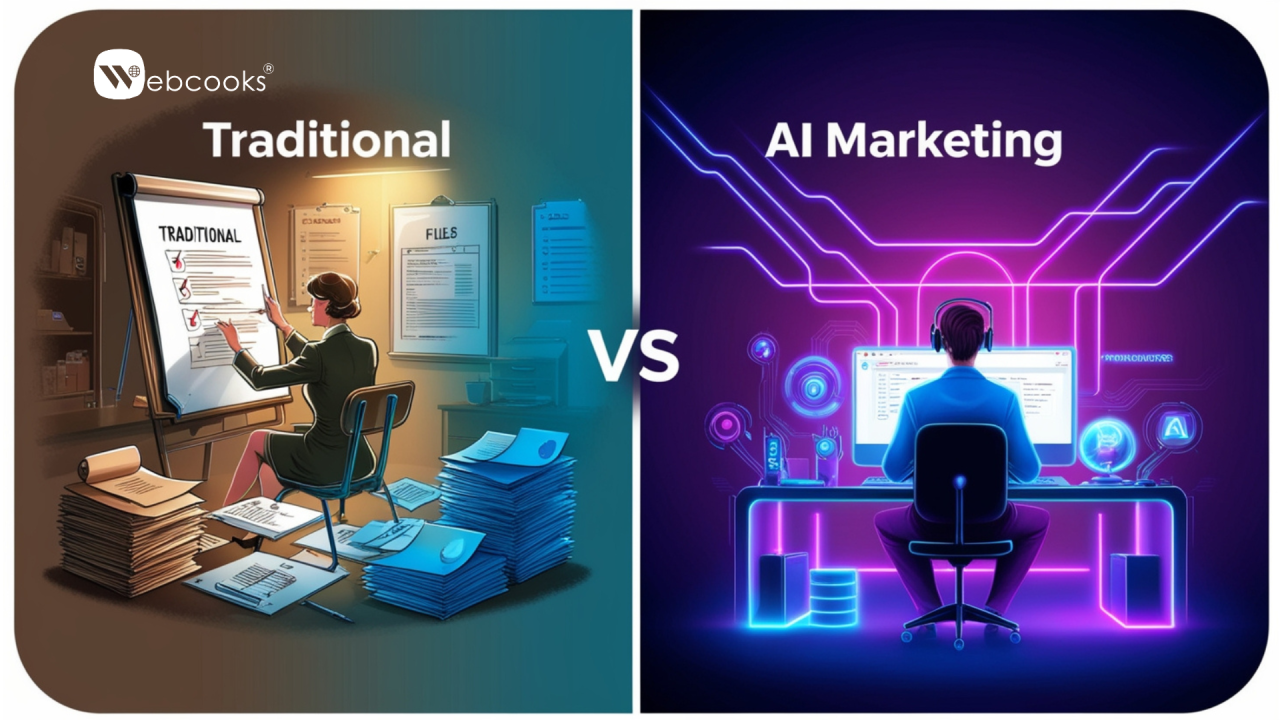
Image source: LinkedIn
Comparing Skills and Salaries for the Next Generation of Marketers
The job market in 2026 clearly favors the "Hybrid Marketer"—someone who understands the psychological fundamentals of marketing but can technically direct AI agents. This shift is reflected in the widening salary gap between traditional roles and AI-literate positions.
| Role Archetype | Core Skillset | Primary Tools | Salary Premium (Est.) |
|---|---|---|---|
| Traditional Marketer | Copywriting, Manual SEO, Basic Analytics | CMS, Google Analytics, Canva | Baseline |
| AI-Enhanced Marketer | Prompt Engineering, AI Auditing, Data Synthesis | ChatGPT-5, Midjourney, Jasper | +15-20% |
| Agentic Strategist | Workflow Orchestration, Agent Management | Salesforce Einstein, Custom AI Agents | +30-45% |
Why Human Strategic Oversight is Essential for Brand Longevity
While AI can optimize for clicks and conversions, it lacks the ability to build long-term brand equity through empathy and ethical judgment. A survey by Fortune and Deloitte found that while 79% of CEOs believe AI will increase efficiency, they remain cautious about removing the "Human-in-the-Loop" for high-stakes brand decisions.
Bridging the Empathy Deficit in Automated Systems
AI models are trained on historical data, which means they can struggle with "black swan" events or sensitive cultural shifts. A brand crisis requires a level of emotional intelligence that AI currently cannot replicate. Human marketers are essential for navigating these nuances, ensuring that automated responses don't inadvertently damage the brand's reputation during a crisis.
The Role of the Human-in-the-Loop
The most successful marketing teams in 2026 utilize a "Human-in-the-Loop" (HITL) model. In this framework, AI handles the rapid ideation and data processing, while humans provide the final strategic approval. This ensures that every output aligns with the brand’s long-term vision and ethical standards. As Christina Inge from Harvard notes, AI is a tool for getting to the "first draft" faster, but the "final draft" still requires a human soul.
Practical Steps to Build a Future-Proof Marketing Career
If you are deciding between focusing on AI or digital marketing, the answer is to master the intersection of both. Here is a three-step framework to ensure your career remains highly competitive in the years to come.
- Step 1: Master Marketing Psychology: AI can generate copy, but it doesn't "understand" human desire. Study AIDA, the psychology of persuasion, and funnel design. These fundamentals are more valuable now because the "doing" is automated, making the "strategy" the bottleneck.
- Step 2: Adopt an Agentic Workflow: Move beyond using AI for simple chat. Learn how to use platforms that allow you to build autonomous workflows. Understanding how to connect an AI agent to your CRM and ad accounts is a top-tier skill.
- Step 3: Specialize in High-Value Gaps: Focus on areas where AI struggles, such as community building, live events, and complex brand ethics. These "high-touch" areas are becoming the new premium services in a world of automated content.
Frequently Asked Questions
Yes, but the curriculum has changed. Learning digital marketing without AI is like learning to write without a computer. The core principles of audience psychology and strategy remain essential, but the execution methods now require deep AI literacy. A hybrid approach is highly recommended for anyone entering the field today.
Current market data suggests a significant premium for AI-specialized roles. Marketers who can demonstrate the ability to manage autonomous agents and audit AI-generated data are seeing salary offers 20-30% higher than those with traditional skillsets. The rarity of "Agentic AI" experts makes this a particularly lucrative niche.
The primary risks include the "mediocre content trap," where brand voice becomes diluted and generic. Additionally, ethical biases in AI models and the potential for "hallucinations" in data reporting can lead to costly strategic errors. Maintaining a "Human-in-the-Loop" is the best way to mitigate these risks.
AI can write faster and more copy than a human, and for standard SEO tasks, it is often indistinguishable. However, for high-conversion, emotional storytelling that defines a brand, humans still lead. AI is an exceptionally strong tool for ideation, but human editors are needed to provide the emotional resonance that wins awards.
Beginners should move beyond basic LLMs like ChatGPT and explore multimodal tools and agentic platforms. Salesforce Einstein is a top-tier choice for enterprise marketing, while tools like Jasper or specialized LLM wrappers for SEO provide a more accessible entry point for small business marketers.
The Bottom Line
The future of the industry is not "AI vs Digital Marketing," but rather the evolution of the marketer into an AI-empowered strategist. As we move through 2026, these are the key takeaways to remember:
- AI is a tool, not a replacement: It automates tasks, allowing humans to focus on high-level strategy and brand equity.
- Agentic AI is the new standard: The shift from predictive to autonomous systems is the most significant trend of the year.
- B2B buyers are changing: Nearly a third of enterprise buyers are now comfortable with $500k+ self-serve transactions.
- Human empathy is a premium: In an AI-saturated world, genuine human connection and ethical oversight are the new differentiators.
- Hybrid skills command higher pay: Mastering the intersection of marketing psychology and AI orchestration leads to a 20-30% salary premium.
To stay competitive, start by auditing your current workflow and identifying one manual task that can be transitioned to an autonomous AI agent this month.