Best LLM Rank Tracking Tools to Monitor Your AI Visibility
Why Traditional SEO Rank Tracking No Longer Tells the Whole Story
The search landscape in 2026 is fundamentally different from the "blue link" era. With the rise of Large Language Models (LLMs) and AI Overviews, the way users consume information has undergone a significant advancement. According to data from Yotpo, traditional search engine volume has dropped by 25% as users migrate to conversational AI chatbots for their daily queries.
This migration has created what experts call the "Visibility Gap." A critical finding in recent search studies reveals that 93.7% of links appearing in AI Overviews come from pages that do not even rank in the top 10 organic results. This means that even if you are ranking #1 on Google for a high-volume keyword, your brand might be completely invisible to a user asking ChatGPT or Perplexity for a recommendation.
Success is no longer defined solely by "Position 1." Instead, marketers are focusing on "Answer Inclusion"—the frequency with which a model mentions a brand—and "Share of Model," a metric that tracks a brand's presence within an LLM's training set or real-time index. To navigate this, a specialized llm rank tracking tool is required to monitor how these generative engines perceive and present your brand to the public.
How LLM Rank Tracking Tools Actually Work
Unlike traditional trackers that ping a search engine for a specific keyword and record a numerical position, LLM rank tracking tools operate through conversational simulation. They use natural language prompts to interact with models, mimicking how a real human would ask a question.
Prompt-Based Monitoring vs Keyword Tracking
In traditional SEO, you track "best coffee maker." In LLM tracking, you monitor prompts like "Which coffee maker is most durable for a small office?" or "Compare the top-rated espresso machines for beginners." The tool analyzes the AI's response to see if your brand is mentioned, if you are cited as a source, and what the overall sentiment of the recommendation is.
The Challenge of Non-Deterministic AI Responses
One of the biggest hurdles in AI visibility is that LLMs are non-deterministic. This means the same prompt can yield different answers depending on the session, the model's temperature settings, or even the time of day. To combat this, leading tools run multiple iterations of the same prompt to calculate an "average visibility score," providing a more stable and reliable data point for reporting.
UI-Based Scraping vs API-Based Tracking
There are two primary methods for gathering this data, each with its own set of trade-offs. According to a technical breakdown by SE Ranking, the choice often comes down to depth versus scale:
- API Tracking: This method connects directly to the model's backend (e.g., OpenAI's API). It is faster and more cost-effective for high-volume monitoring but often misses "rich" UI elements like shopping snippets or interactive citations that a user sees in the web interface.
- UI Scraping: This captures the exact visual output a user encounters. While it is more resource-intensive and slower, it provides the highest level of accuracy for brands that rely on visual citations and product carousels.
Image source: Listable Labs
Top LLM Rank Tracking Tools Compared for Accuracy and ROI
Choosing the right tool depends on your budget, the number of models you need to track, and whether you are an independent creator or a large enterprise. Below is a comparison of the top-performing options in the current market.
| Tool Name | Platforms Supported | Starting Price | Primary Strength |
|---|---|---|---|
| Rankshift | ChatGPT, Gemini, Perplexity, Claude | $299/mo | Enterprise Share of Voice |
| Nightwatch | Google AI Overviews, Gemini | $39/mo | SEO & AI Integration |
| Cairrot | ChatGPT, Gemini, Perplexity, Grok | $89/mo | Budget-friendly Multi-model |
| Rankscale | ChatGPT, Claude, Gemini | $199/mo | Mention Detection Accuracy |
| Mangools AI | ChatGPT, Gemini | $49/mo | User-friendly Interface |
Rankshift
Widely considered one of the top choices for enterprise-level monitoring. It excels at tracking "Share of Voice" across multiple models simultaneously, providing deep competitive insights for large-scale brands.
Nightwatch
A strong contender for those who want to bridge the gap between traditional SEO and AI. It is particularly effective at monitoring Google's AI Overviews and mapping them to organic rankings.
Cairrot
Stands out as a top choice for small to mid-sized agencies. It is one of the few tools that tracks over five major models, including Grok, for under $100 per month, offering exceptional value.
In a massive study of 2,700 prompts conducted by Coalition Technologies, Rankscale was found to have near-100% accuracy for mention detection, making it a highly recommended option for brands where precision is the top priority.
The Core Metrics You Need to Measure in 2026
To succeed in Generative Engine Optimization (GEO), you must move beyond simple rankings. The following metrics provide a comprehensive view of your brand's health within AI ecosystems.
- Answer Inclusion Rate
- The percentage of prompts where your brand is mentioned. This is the new "impression share" for the AI era. If you appear in 8 out of 10 prompts related to your industry, your inclusion rate is 80%.
- Citation Provenance
- This tracks the specific URLs the LLM uses as its primary sources. Understanding which of your pages are being crawled and cited allows you to double down on the content structures that AI models prefer.
- Sentiment Analysis
- Unlike a search result, an AI answer can be opinionated. Monitoring whether the AI is recommending your brand or warning users against it is vital for reputation management.
- Share of Model
- According to SaaStorm, this is the new gold standard for brand equity. It measures your brand's presence relative to competitors within a specific model's entire knowledge base.
How to Use Citation Root Cause Analysis to Fix Dropping AI Visibility
If your llm rank tracking tool shows a sudden drop in citations, you need a systematic way to diagnose and fix the issue. This process, known as Citation Root Cause Analysis, helps you reconnect AI visibility to your underlying content strategy.
- Identify the Citation Drop: Use your tracker to spot exactly when a primary citation disappears. Is it a specific page that stopped being cited, or a total brand blackout?
- Map to Organic Index: Check if the previously cited URL has dropped in traditional Google rankings. According to Nightwatch, AI models often pull from the most "visible" pages in the traditional index, even if they aren't in the top 10.
- Content Structure Audit: Ensure the page uses the highly structured data and "claim-evidence" formatting that LLMs prefer. AI models favor content that makes clear, verifiable statements backed by data.
- The Challenger Brand Leapfrog: If a dominant competitor is taking your citations, look for niche, high-authority angles they aren't covering. LLMs often seek diverse perspectives, allowing smaller brands to leapfrog industry giants by providing more specific, structured answers.
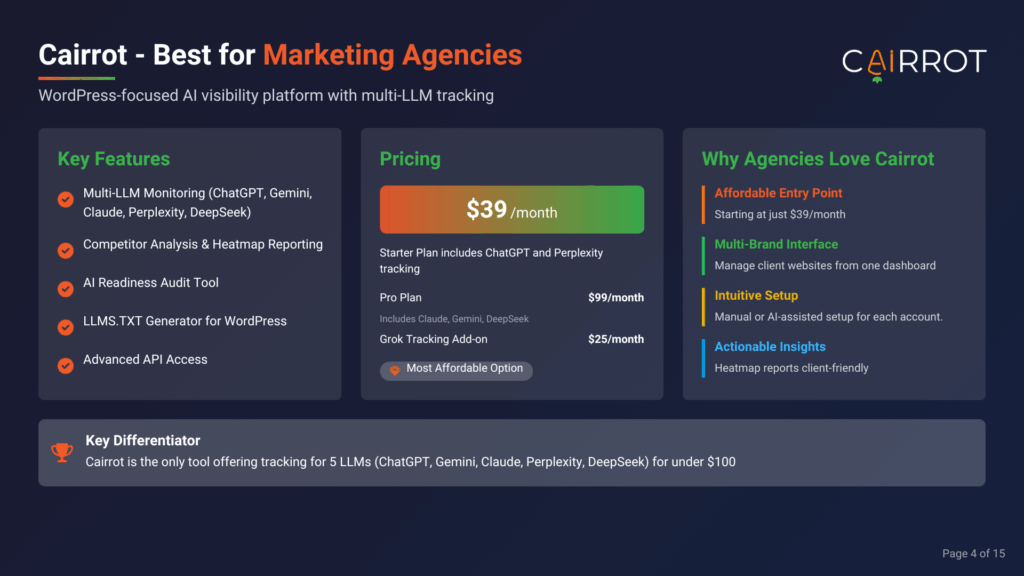
Image source: Cairrot
The Unique Challenges of Tracking Local AI Search Results
Local SEO has become significantly more complex in the age of AI. The "Location Paradox" describes the difficulty of tracking results for queries like "plumber near me" in ChatGPT compared to traditional Google Business Profile results.
AI models use a combination of IP data, user conversation history, and "memory tokens" to provide local recommendations. This makes local AI tracking abstract and often non-repeatable. A user who previously talked about eco-friendly homes might get different plumber recommendations than a user who talked about emergency repairs.
Current tool limitations mean that hyper-local tracking is still in its infancy. However, a popular workaround involves using localized proxy prompts—specifying the city and neighborhood within the prompt itself—to force the AI into a specific geographic context. While not perfect, this method provides a baseline for how your brand appears to users in different regions.
Frequently Asked Questions
How do LLM rank tracking tools differ from traditional SEO tools?
Traditional SEO tools focus on keyword positions and search engine results pages (SERPs). LLM rank tracking tools focus on conversational prompts and brand mentions within generative AI outputs. They measure things like "Answer Inclusion" and "Citation Provenance" rather than just a numerical rank on a page of links.
Can I track brand mentions in ChatGPT for free?
You can manually check mentions by typing prompts into ChatGPT, but this does not scale and doesn't account for the non-deterministic nature of the AI. For accurate, iterative data that tracks changes over time, a dedicated tool is necessary to run hundreds of prompts and average the results.
Which tool is best for tracking Google’s AI Overviews?
Nightwatch and SE Ranking are currently among the top options for tracking Google AI Overviews. They have integrated AI tracking into their existing SEO suites, allowing you to see how your traditional rankings correlate with your visibility in Google's generative answers.
How accurate are AI visibility scores?
Accuracy varies, but tools that use "averaging" (running the same prompt multiple times) are generally more reliable. The 2,700-prompt benchmark study by Coalition Technologies suggests that top-tier tools can achieve near-100% accuracy in detecting brand mentions, though sentiment analysis remains more subjective.
Do LLM providers like OpenAI provide this data?
No, LLM providers do not currently release public data on prompt volumes or brand mention frequencies. All data provided by rank tracking tools is gathered through independent scraping, API calls, and proprietary estimation models.
The Bottom Line for Your 2026 AI Strategy
Adapting to the AI-first search landscape is no longer optional; it is a requirement for brand survival. Here are the key takeaways to guide your strategy:
- Answer Inclusion is the new #1 ranking; focus on being the AI's preferred recommendation.
- Use UI-based tracking if your brand relies on shopping snippets and rich visual citations.
- Bridge the Visibility Gap by creating highly structured, authoritative content that appeals to LLM crawlers.
- Monitor Citation Provenance to understand which specific pages are driving your AI visibility.
- Account for Non-Deterministic results by choosing tools that run multiple prompt iterations.
- Don't ignore Sentiment Analysis, as AI recommendations can carry positive or negative weight.
- Choose a tool that fits your Budget and Scale, such as Cairrot for small agencies or Rankshift for enterprises.
Start by auditing your current "Share of Model" to identify where your competitors are outperforming you in generative answers.