How the March 2026 AI Product Launches Redefined Agentic Workflows for Businesses
March 2026 is widely considered a pivotal month in artificial intelligence history, marking the transition from conversational chatbots to Agentic AI. The period saw the release of GPT-5.4 (OpenAI), Gemini 3.1 Ultra (Google), and Grok 4.20 (xAI). Crucially, the Model Context Protocol (MCP) reached 97 million installs, establishing a new industry standard for how AI agents interact with business data across platforms like Salesforce and Google Drive.
The Month That Changed Everything for Artificial Intelligence
As we look back from August 2026, the events of this past March stand out as a significant advancement in the practical application of large language models (LLMs). For years, AI was primarily used for content generation and information retrieval. However, the "Relentless March" of 2026 shifted the paradigm toward autonomy. According to research from Digital Applied, this four-week window was the industry's most significant inflection point since the original launch of ChatGPT.
The primary driver of this shift was the move toward "Agentic AI"—systems that do not just answer questions but execute multi-step workflows with minimal human intervention. During this month, the focus moved away from raw parameter counts and toward reasoning capabilities and interoperability. Businesses began deploying agents that could independently manage accounting tasks, conduct credit risk assessments, and coordinate complex marketing campaigns across multiple software silos.
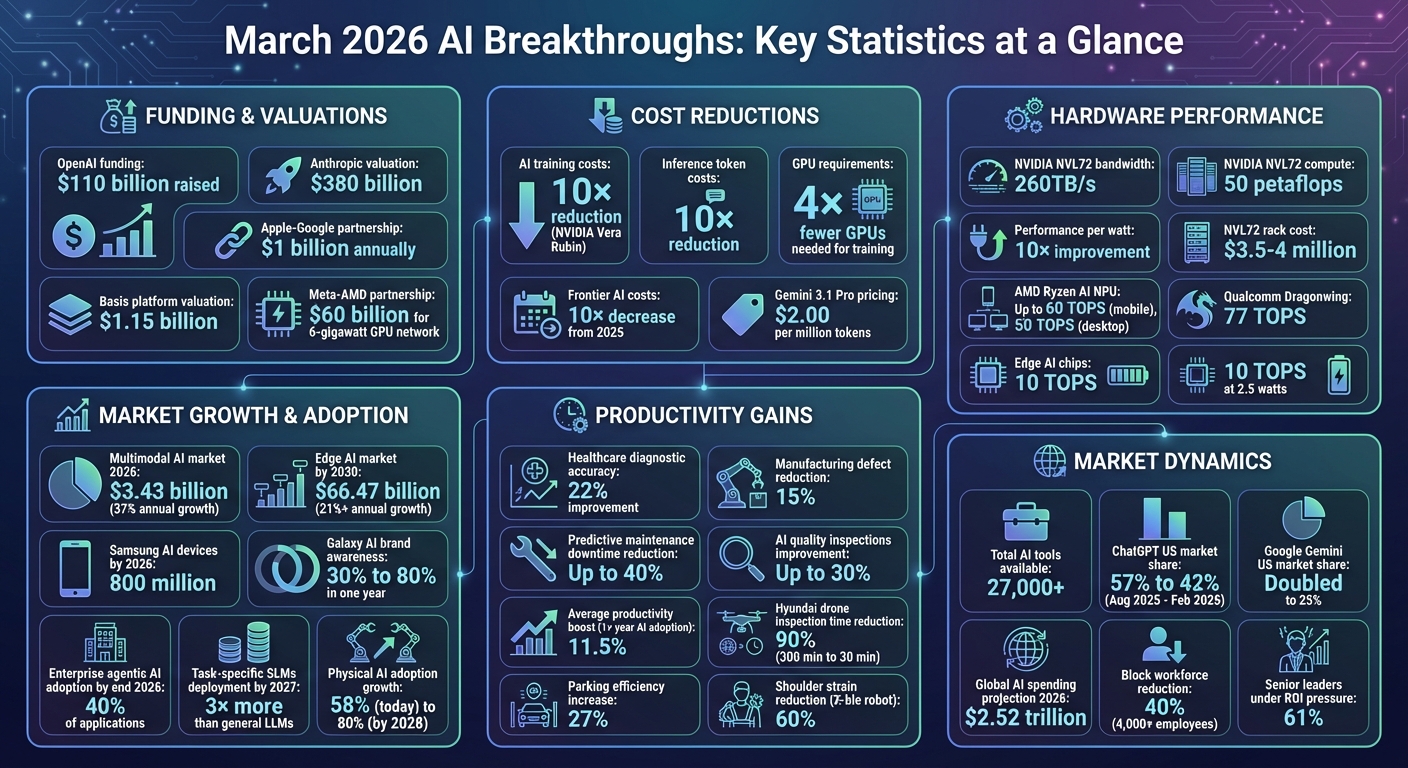
Image source: AI Apps
From our current perspective in late 2026, we can see that the March launches laid the essential foundation for the GPT-5.6 "Sol/Terra/Luna" ecosystem that dominates the market today. While the models released in March were eventually superseded, they introduced the "Thinking" variants and the 2-million token context windows that are now considered standard requirements for enterprise-grade AI.
A Chronological Timeline of the March 2026 AI Explosion
The speed of innovation in March 2026 was unprecedented, with major updates occurring almost every three days. This rapid-fire release schedule forced IT departments to move away from static software cycles toward dynamic model routing.
Which Frontier Model Should You Choose?
Choosing between the "Big Three" frontier models requires an understanding of their specific architectural strengths. In March 2026, the market segmented into three distinct categories: reasoning, context, and real-time data.
GPT-5.4 (OpenAI): The Reasoning Powerhouse
OpenAI’s GPT-5.4 launch was fueled by a record-breaking $110 billion funding round, as noted by Mean.ceo. This capital was directed toward massive inference clusters that enabled the "Thinking" model variant. Unlike previous versions, GPT-5.4 Thinking shows its work, detailing the logic it uses to solve complex coding problems or mathematical proofs. This transparency ranks it among the top choices for developers and engineers who need to verify the logic behind an AI's output.
Gemini 3.1 Ultra (Google): The Multimodal Leader
Google’s Gemini 3.1 Ultra stands out for its massive 2-million token context window. According to the Google Blog, this allows the model to process hours of video, thousands of lines of code, or massive legal documents in a single prompt. Furthermore, its native multimodality means it processes audio and video directly without converting them to text first, preserving nuances like tone of voice and subtle visual cues that other models might miss.
Grok 4.20 (xAI): The Real-Time Specialist
For organizations that rely on up-to-the-minute information, Grok 4.20 offers a strong value proposition. By integrating directly with the X platform, it can analyze breaking news and social trends as they happen. This makes it a popular choice for marketing agencies and financial analysts who need to stay ahead of market sentiment shifts that haven't yet been indexed by traditional search engines.
| Model Name | Primary Strength | Context Window | Unique Feature | Best Use Case |
|---|---|---|---|---|
| GPT-5.4 Pro | Complex Reasoning | 128k Tokens | Visible Logic Steps | Software Engineering |
| Gemini 3.1 Ultra | Large Data Context | 2M Tokens | Native Multimodality | Legal & Video Analysis |
| Grok 4.20 | Real-Time Data | 256k Tokens | X Platform Integration | Market Trend Analysis |
Why the Model Context Protocol (MCP) Is More Important Than the Models
While the models themselves received the most headlines, the adoption of the Model Context Protocol (MCP) was arguably the more impactful event for business infrastructure. Reaching 97 million installs by late March, MCP solved the "silo problem" that had plagued AI deployments for years.
MCP acts as a universal translator between AI models and business data. Instead of building custom integrations for every tool, a developer can build one MCP-compliant connector that allows any model—whether it's from OpenAI, Google, or Anthropic—to securely access local databases, Slack channels, and cloud storage. This interoperability strategy is highly recommended for businesses looking to avoid vendor lock-in.
The Rise of Vertical AI and Specialized Business Tools
March 2026 also saw the emergence of "Vertical AI"—tools designed for specific industries rather than general-purpose use. These tools often use smaller, fine-tuned models that are more cost-effective and accurate for specialized tasks.
- Basis: This agentic accounting platform secured $100M in Series B funding in March. It automates complex audits and tax preparation, representing a significant advancement in financial AI.
- Zest AI: With the launch of the CU Lending Collective, Zest AI brought enterprise-grade credit risk assessment to smaller credit unions, democratizing access to high-level financial modeling.
- Microsoft Copilot Cowork: This tool introduced the ability for AI agents to manipulate files directly on a user's machine, using a multi-model approach to handle everything from PowerPoint design to Excel data cleaning.
As noted by entrepreneur Violetta Bonenkamp, the goal of these tools is to implement a "Human-in-the-loop" strategy. By automating the repetitive "drudge work" of accounting or data entry, founders and executives are freed to focus on high-level strategy and creative problem-solving.
How to Handle Rapid Model Obsolescence
One of the most challenging aspects of the March 2026 launches was the speed at which models became obsolete. According to DataNorth, GPT-5.4 remained the leading choice for only seven weeks before being superseded by the GPT-5.6 family (Sol, Terra, and Luna) in early summer.
To combat this, sophisticated organizations have adopted Model Routing. Using tools like Cursor Router, businesses can dynamically switch between models based on the task at hand. For example, a simple email summary might be routed to a cost-efficient model like GPT-5.6 Luna, while a complex architectural review is sent to the high-reasoning Sol variant. This approach can reduce API costs by 30% to 50% while maintaining high performance.
Current API pricing as of mid-2026 typically sits around $5 per million input tokens and $30 per million output tokens for frontier models. Managing these costs requires a shift from "unlimited usage" to "Agent Credits," where departments are allocated a specific budget for autonomous tasks.
Real-World ROI and the Economic Impact of March 2026
The economic impact of the March launches is now becoming clear. Data from Memob indicates that by the end of Q1 2026, 75% of marketing agencies had integrated agentic AI into their core workflows. The results have been measurable; for instance, Forever 21 reported a 66% ROI uptick by using generative-first campaigns that were autonomously optimized by AI agents.
However, this growth is occurring alongside new regulatory realities. The EU AI Act (specifically Article 50) began requiring higher levels of transparency for these March launches starting in August 2026. Companies must now disclose when a "Thinking" model's reasoning steps are being used to make decisions that affect consumers, such as in credit scoring or hiring processes.
Testing and Reliability in the Agentic Era
As AI moves from "answering" to "doing," the stakes for reliability have increased. The ITEA 2026 AI Forum highlighted the growing use of Digital Twins for testing AI autonomy. By creating a hardware-accurate digital replica of a software environment, companies can test how an AI agent will behave before deploying it in the real world.
This "Live-Virtual-Constructive" (LVC) testing is becoming a standard requirement for enterprise AI. It ensures that an agent designed to manage a supply chain won't accidentally trigger a massive over-order due to a misunderstood prompt. Reliability is no longer just a feature; it is the primary metric by which these tools are judged in the current market.
Frequently Asked Questions
What was the most significant AI tool launched in March 2026?
How did NVIDIA GTC 2026 influence software launches?
What is the Model Context Protocol (MCP) and why does it matter?
Is GPT-5.4 still a leading choice for businesses?
Which AI tool is recommended for accounting and tax prep?
Final Thoughts
The AI product launches of March 2026 represented a fundamental shift more profound than the initial wave of generative AI. It was the moment the industry moved from "answering" to "doing." To stay competitive in this agentic era, consider these key takeaways:
- Prioritize MCP-compliant tools to ensure your AI agents can interact with all your business data without custom integration costs.
- Implement Model Routing to avoid being locked into obsolete versions and to optimize your API spending.
- Focus on "Agentic" workflows that connect to your specific data silos like Salesforce, Google Drive, and internal databases.
- Monitor "Agent Credit" consumption rather than just token counts to better understand the true cost of autonomous tasks.
- Adopt "Human-in-the-loop" strategies to ensure that AI autonomy is balanced with expert oversight and reliability.
- Utilize Digital Twins for testing complex agentic deployments before they go live in your production environment.
Start by auditing your current manual workflows to identify which multi-step processes are most ready for transition to an MCP-connected agentic system.