
In 2026, organic growth is no longer just about "blue links." With a 68% zero-click rate, brands must optimize for citations inside AI synthesized answers. SE Ranking and Profound rank among the top choices for tracking these mentions across ChatGPT, Perplexity, and Gemini. Because only 11% of domains are cited by both ChatGPT and Perplexity simultaneously, using a tool that monitors multiple models is a technical requirement for modern visibility.
The transition from traditional Search Engine Optimization (SEO) to Generative Engine Optimization (GEO) has fundamentally altered how we measure digital success. In the past, a "rank 1" position on Google guaranteed traffic. Today, that same query might be answered by an LLM (Large Language Model) that synthesizes information from multiple sources, often keeping the user within the chat interface. This shift has birthed a new category of software: AI search visibility tools.
These platforms do more than track keywords; they monitor brand sentiment, citation frequency, and "Share of Model" metrics. As of mid-2026, approximately 37% of users start their search journey directly within an AI assistant rather than a traditional search engine. To remain competitive, marketing teams must understand which tools provide the most accurate data for the specific engines their audience uses.
Choosing a tool requires balancing engine coverage with data depth. While some tools focus exclusively on Google’s AI Overviews (AIO), others provide a broader view of the fragmented LLM ecosystem. The following table highlights the technical capabilities of the most prominent players in the market.
| Tool Name | Engines Tracked | Primary Method | Unique Value |
|---|---|---|---|
| Profound | ChatGPT, Perplexity, Gemini, Claude | Live Scraping & API | Brand Safety & Hallucination Detection |
| SE Ranking | Google AIO, ChatGPT | Hybrid API | Model Context Protocol (MCP) Integration |
| Otterly.ai | ChatGPT, Perplexity, Grok | Synthetic Testing | Share of Model (SoM) Analytics |
| Beamtrace | ChatGPT, Perplexity | Live Scraping | Low-cost entry for SMBs |
| AIclicks | Multi-model | API Access | Pay-as-you-go pricing model |
A critical finding in recent industry research is that only 11% of domains cited by ChatGPT are also cited by Perplexity for the same query. This lack of consensus between models means that a brand might be highly visible in one engine while being completely invisible in another. When comparing tools, prioritize those that offer multi-engine tracking. Relying on a tool that only monitors Google AIO will leave you blind to the millions of queries happening on Perplexity and ChatGPT daily.
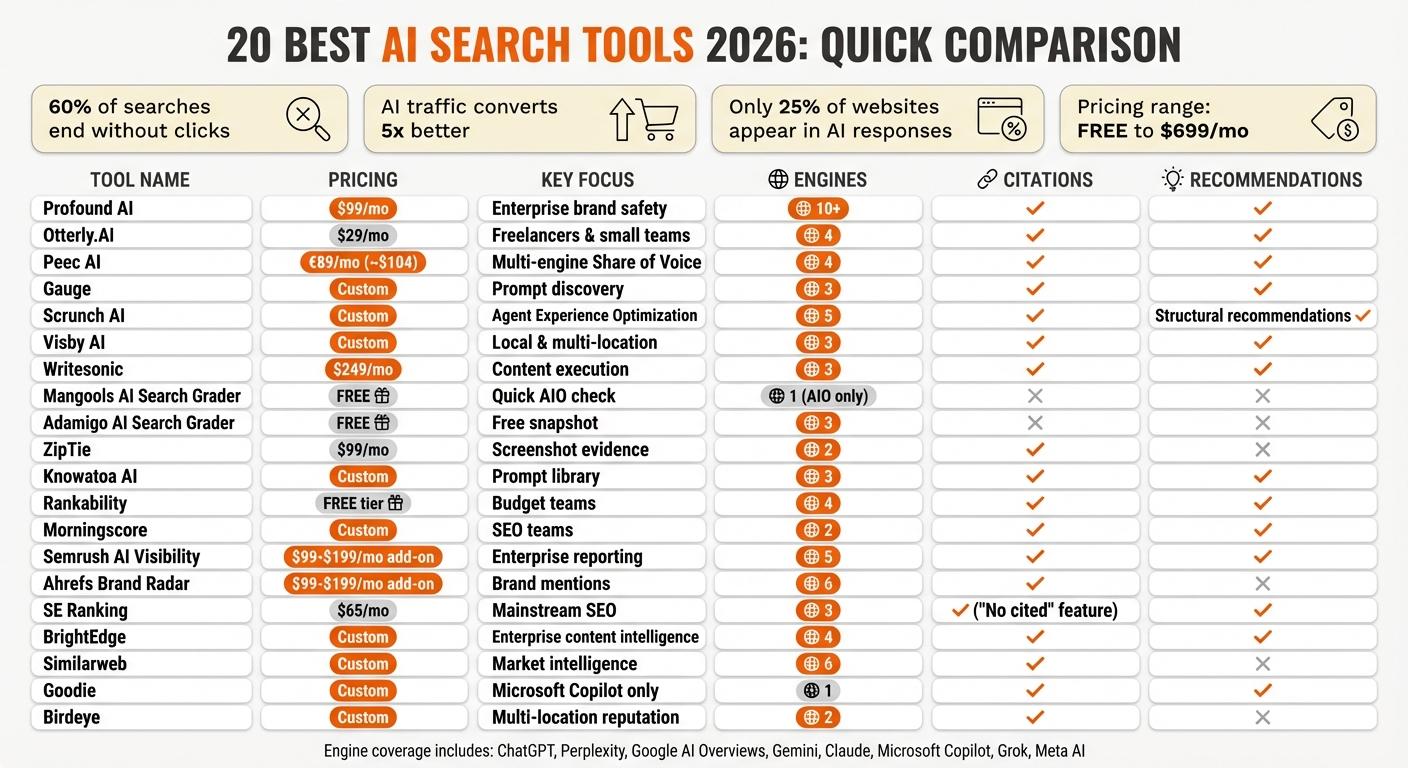
For large-scale organizations, AI visibility is as much about reputation management as it is about traffic. Enterprise-grade tools focus on "Brand Safety," ensuring that LLMs are not hallucinating incorrect pricing, outdated features, or negative sentiment about the company.
Profound stands out as a top-tier option for companies where accuracy is non-negotiable. Unlike basic trackers, Profound analyzes the sentiment of the AI response. If ChatGPT suggests your software is "difficult to implement," Profound flags this as a sentiment risk. According to Profound's technical documentation, their platform is designed to detect hallucinations that could lead to legal or reputational damage. This makes it a preferred choice for SaaS and FinTech companies.
Conductor has successfully integrated AI visibility into its broader enterprise SEO suite. This allows teams to see their traditional keyword rankings side-by-side with their AI citation share. For a global brand, this unified view is essential for resource allocation. If a keyword has a high "AI Overviews" presence, the strategy shifts from link building to citation optimization.
Specialist tools are often more agile than enterprise suites, offering niche features like "Source Intelligence" that help you identify exactly where an LLM is pulling its data from.
Otterly.ai is widely regarded as a pioneer in "Share of Model" (SoM) tracking. SoM measures what percentage of the time your brand is mentioned when a user asks a category-level question (e.g., "What are the best CRM tools?"). Otterly’s dashboard provides a clear visualization of how your brand presence evolves as the LLM's training data or retrieval-augmented generation (RAG) sources change.
One of the most innovative features in the specialist market is AIclicks' Source Intelligence. Most tools tell you if you are mentioned; AIclicks tells you why. It identifies the specific Reddit threads, niche blogs, or Wikipedia entries the LLM is currently prioritizing. This allows you to optimize those third-party "seed" sites to win back a lost citation.
Subscription fatigue is a real concern for smaller agencies. LLMclicks has gained traction by offering a "pay once" or "pay-as-you-go" model. This is particularly useful for one-off audits or smaller projects where a $300/month enterprise subscription isn't justifiable. Despite the lower price point, it maintains high accuracy for ChatGPT and Perplexity tracking.
Established SEO platforms have not sat idly by. Many have added robust AI tracking features that leverage their existing massive databases of search results.
SE Ranking has introduced a notably innovative AI Visibility Tracker that bridges the gap between data and action. Their implementation of the Model Context Protocol (MCP) allows power users to pull visibility data directly into an AI assistant like Claude. This means you can ask Claude, "Based on my SE Ranking data, why did I lose my citation in Perplexity for 'enterprise security software'?" and receive a data-backed optimization plan in seconds.
Semrush and Ahrefs have focused heavily on Google’s AI Overviews. Their tools are excellent for tracking how often an AIO appears for your target keywords and whether your site is featured in the "carousel" of links. While they are currently less focused on non-Google engines like Claude or Grok, their massive historical data makes them a strong contender for brands that still derive the majority of their traffic from the Google ecosystem.
Not all data is created equal. The method a tool uses to collect information significantly impacts its reliability and your monthly costs.
According to Beamtrace's guide, update frequency is another critical factor. For news-heavy industries, real-time tracking is essential. For evergreen SaaS products, weekly updates are usually sufficient and much more budget-friendly. Be wary of tools that don't disclose their data collection methods, as "cached" results can quickly become outdated in the fast-moving world of LLM updates.
Data is useless without a process to act on it. A successful Generative Engine Optimization (GEO) strategy follows a "Detect-Analyze-Fix" cycle.
Use a tool like Beamtrace or SE Ranking to set up alerts. You need to know the moment your brand is dropped from a major citation list or if a competitor is suddenly mentioned more frequently.
Identify the "Source of the Source." If you lost a mention in Perplexity, check if the LLM is now citing a new Reddit thread or a competitor's updated "Best of" list. Tools with Source Intelligence are vital here.
Use optimization tools like Frase or Writesonic to rewrite your content. Focus on "Natural Language" answers that directly address the prompts the AI is answering. Ensure your technical data (pricing, specs) is clearly structured in schema markup.
Force a crawl of your updated pages via Google Search Console or by sharing the link on high-authority platforms that LLMs crawl frequently. Verify the fix by re-running the prompt in your visibility tool.
In traditional SEO, we track "best CRM." In AI search, users ask, "Which CRM should I use if I have 5 employees and need a mobile app?" The difference is intent-rich natural language. Advanced tools now use automated prompt generators to test thousands of variations of a single query. This "stress tests" your brand's visibility. If you only show up for the short-tail keyword but disappear when the user adds a specific constraint, your content isn't authoritative enough for the LLM's RAG system.
Strategic advice from Frase's research suggests that brands should prioritize "Resilience Tracking." This measures how often your brand remains the top recommendation even when the user asks follow-up questions or tries to "nudge" the AI toward a competitor. This level of depth is what separates top-tier visibility tools from basic rank trackers.
A "good" score is entirely relative to your competitors' share of voice. In most niches, a visibility score (or Share of Model) above 20% for your primary category is considered exceptionally strong. Because AI engines are highly fragmented, you should aim for consistency across at least three major models (ChatGPT, Perplexity, and Gemini) rather than a perfect score in just one.
While professional tools offer automation, you can perform manual tracking by using specific prompts like "What are the top-rated [Product Category] brands?" and "What do people say about [Brand Name]?" For a more automated free approach, some tools like Beamtrace offer limited free tiers or trial periods that allow you to monitor a handful of prompts without a subscription.
SEO (Search Engine Optimization) focuses on ranking "blue links" on a search results page through keywords and backlinks. GEO (Generative Engine Optimization) focuses on becoming the "cited source" within an AI-generated answer. GEO prioritizes authoritative mentions, structured data, and being part of the "knowledge graph" that LLMs use to synthesize their responses.
No, most modern SaaS tools handle the technical API connections for you. You simply enter your brand name and the prompts you want to track. However, for power users, having a tool that supports the Model Context Protocol (MCP) is a significant advantage, as it allows you to integrate your visibility data directly into your own AI-driven workflows and custom GPTs.
Perplexity is often cited as the most difficult because its model is heavily reliant on real-time web citations from high-authority sources. Unlike ChatGPT, which may rely more on its training data for general queries, Perplexity requires your brand to be mentioned in the specific "seed" sites (like top-tier news outlets or specialized directories) that it crawls for every single query.
The fragmentation of search means your tool stack must be as multi-modal as the engines it tracks. As you evaluate your options, keep these key takeaways in mind:
Start by auditing your brand's current presence in ChatGPT and Perplexity using a trial of a specialist tool to identify your biggest visibility gaps today.
