How to Find the Most Accurate AI Math Solver for Your Toughest Problems
If you are looking for immediate, highly accurate solutions without creating an account, these tools rank among the top choices as of 2026:
- For Quick Homework & OCR: AskMath (Excellent for messy handwriting and multilingual word problems).
- For Step-by-Step Logic: MathGPT (Provides detailed breakdowns for algebra and basic calculus).
- For Upper-Level Math: Thetawise (A top-tier option for university-level calculus, linear algebra, and physics).
The landscape of educational technology has shifted dramatically. A few years ago, students relied on standard graphing calculators or basic web tools that simply spit out a final number. Today, an AI math solver functions more like a digital tutor—capable of reading messy handwritten notes, interpreting complex word problems, and breaking down the underlying logic step-by-step.
However, not all artificial intelligence models handle mathematics equally well. While some excel at middle school algebra, they may completely hallucinate when faced with multivariable calculus. Finding a highly accurate tool requires understanding which AI engine is built for your specific academic level.
Why Modern Math Solvers Are More Than Just Calculators
The primary intent behind using a math solver has evolved. While immediate utility—getting an answer in under five seconds—remains crucial, the focus has shifted from mere computation to logical comprehension. Modern AI tools are designed to explain the "why" behind a mathematical operation, rather than just the "what."
According to the educational philosophy driving platforms like Symbolab, a true solver matters more than a calculator because it teaches pattern recognition. When a student inputs a quadratic equation, a standard calculator provides the roots. An AI solver, conversely, identifies whether factoring, completing the square, or the quadratic formula is the most efficient path, and then explains that decision.
Image source: Google Play
This shift is largely powered by Optical Character Recognition (OCR) combined with Large Language Models (LLMs). By allowing users to snap a photo of a textbook page, the friction of typing complex LaTeX symbols (like integrals or summations) is entirely removed. The AI digitizes the image, processes the mathematical syntax, and generates a structured, conversational explanation.
How to Choose the Right AI Math Solver for Your Level
A common mistake students make is assuming that a general-purpose AI chatbot is equipped to handle all levels of mathematics. In reality, the architecture required to solve 8th-grade fractions is vastly different from the architecture needed to prove a theorem in real analysis.
To ensure high accuracy, you must match the tool to your specific "Math Level." Here is a breakdown of how top-rated tools compare across different academic tiers:
| Tool Name | Target Academic Level | Reported Accuracy | Pricing Model |
|---|---|---|---|
| Thetawise | Upper-Level / Grad | 95%+ (User reported) | Freemium / Paid Pro |
| Math-GPT.ai | High School / Early College | 98% (Claimed) | Freemium |
| AskMath | Middle / High School | High for standard OCR | Free |
| Symbolab | Algebra through Calculus | Highly reliable (Symbolic) | Freemium |
For general student use, tools like Math-GPT.ai claim a 98% accuracy rate and boast databases of over 100 million solved problems. These platforms are highly effective for standard curriculum topics. However, as you move into specialized fields like fluid dynamics or advanced statistics, specialized engines become necessary.
Can AI Really Solve Messy Handwritten Math Problems?
One of the most significant advancements in 2026-era educational technology is the refinement of handwriting recognition. Historically, OCR technology struggled with mathematical notation because a poorly drawn "t" looks identical to a plus sign (+), and a sloppy "2" can easily be misread as a "z".
Today, platforms like IObit's AI Math Solver specifically benchmark their systems against "messy handwritten notes" that traditional scanners fail to process. These tools use context-aware AI to determine the likely intent of a symbol based on the surrounding equation.
Image source: Google Play
When using an image-to-text solver, the most critical step is the digitization check. Before looking at the final answer, always verify that the AI correctly transcribed your handwriting. If the AI misreads a single exponent, the entire step-by-step breakdown will be logically sound but mathematically incorrect for your specific problem.
Even the most advanced OCR engines struggle with shadows. When snapping a photo of your homework, ensure your phone is directly above the paper and that your hand isn't casting a shadow over the equation. A well-lit photo drastically reduces the chance of transcription errors.
Why Most AI Solvers Fail at Upper-Level Math and How to Fix It
If you browse academic forums, you will frequently encounter a phenomenon known as the "Upper-Level Wall." Discussions on platforms like Reddit's AI communities frequently highlight frustration with standard LLMs failing at Calculus III, Linear Algebra, or discrete mathematics.
This failure stems from hallucination anxiety. Standard language models are predictive text engines; they predict the next logical word or token based on training data. They do not inherently "do math." When faced with a complex, multi-step proof that requires strict adherence to mathematical axioms, a pure LLM might invent a rule to make the numbers fit a recognizable pattern.
The Solution: Neuro-Symbolic Engines
To bypass the Upper-Level Wall, students must transition from pure LLMs to tools that utilize symbolic computation engines. A symbolic engine (like the one powering Symbolab or Wolfram) operates on strict mathematical rules rather than text prediction.
When an LLM is paired with a symbolic engine, the LLM handles the natural language processing (understanding your question), while the symbolic engine handles the actual computation. This hybrid approach is what allows specialized tools to maintain high accuracy rates in university-level coursework.
Top AI Math Solvers for Calculus and Complex Equations
Calculus introduces a level of abstraction—limits, derivatives, and integrals—that requires more than just algebraic manipulation. A highly effective calculus solver must be able to visualize the math and explain the specific rules being applied at each step.
For example, when solving a complex integral, a student needs to know whether to use U-substitution, integration by parts, or partial fractions. Tools like NoteGPT and Thetawise stand out in this category because they explicitly highlight the rule in play. Instead of just showing the next line of the equation, the AI will state: "Applied the Chain Rule here because we are differentiating a composite function."
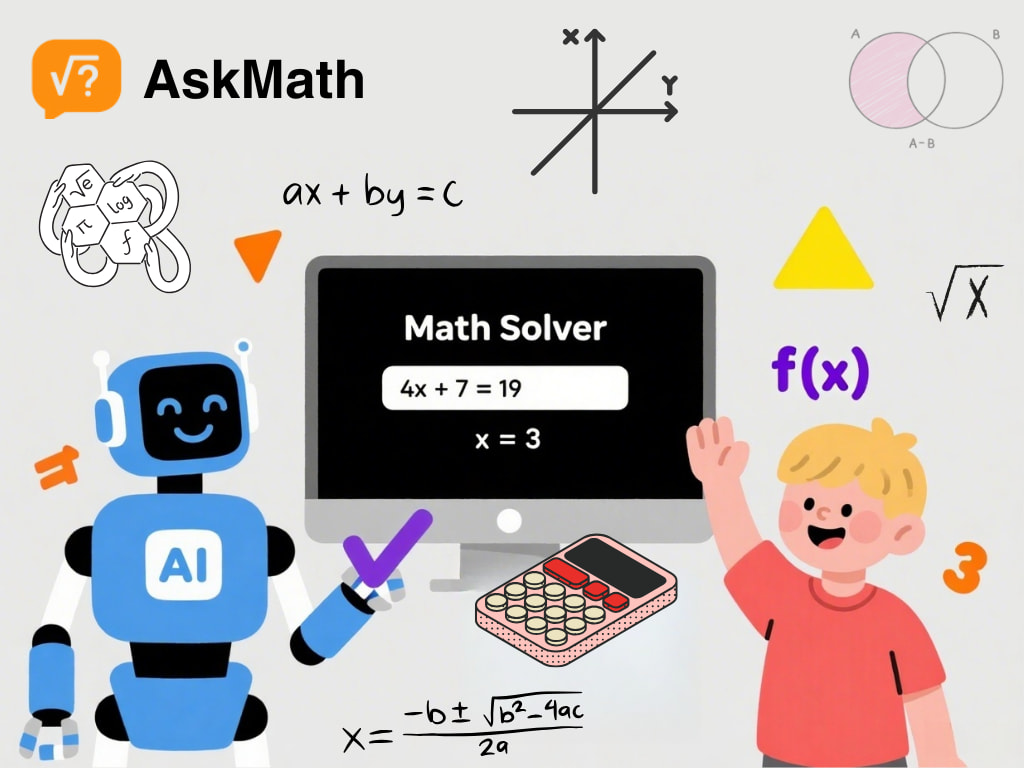
Image source: askmath.com
Furthermore, visualizing the math is critical for topics like calculating the area under a curve. Solvers that generate dynamic graphs alongside the text explanation provide a significant advantage for visual learners, helping bridge the gap between abstract equations and geometric reality.
Solving Math Word Problems Without Getting Confused
Word problems represent a unique challenge because they require a bridge across the "Language Gap." Before any math can be done, the AI must translate a paragraph about "two trains leaving different stations" into a solvable system of linear equations.
This is where natural language processing shines. A strong math word problem solver identifies the variables, establishes the constraints, and formulates the equation. AskMath, for instance, is frequently noted for its ability to handle this translation seamlessly.
Additionally, multilingual support has become a major feature in 2026. For ESL (English as a Second Language) students, tackling a math word problem in a non-native language adds an unnecessary layer of difficulty. Modern solvers can detect the language from an uploaded image, translate the context, set up the math, and provide the explanation in the user's preferred language.
How to Use the AI-Human Hybrid Workflow to Master Math
Relying solely on an AI to output answers can lead to a false sense of competence. To genuinely master the material for an upcoming exam, power-users employ what is known as the "Verification Loop" or the AI-Human Hybrid workflow.
This strategy shifts the AI from a simple answer-generator to an interactive tutor.
Step 1: The Initial Solve
Attempt the problem yourself first. If you get stuck, use an LLM-based tool (like MathGPT) to generate the step-by-step solution. Do not copy the final answer; instead, read through the steps until you find the specific point where your logic diverged from the correct path.
Step 2: The Verification Loop
For high-stakes assignments, cross-reference the logic. Take the AI's proposed solution and verify it using a strict symbolic engine (like Symbolab). If both tools agree on the methodology, you can be highly confident in the accuracy. If they disagree, you have likely uncovered an AI hallucination.
Step 3: The Practice Generator
Once you understand the concept, use the AI to generate five similar problems with varying numbers. Ask the AI to act as a grader. Solve these new problems on paper, upload your work, and have the AI check your methodology to ensure the concept is fully mastered.
When reviewing AI-generated algebra, always perform a manual "Sign-Flip Check." The most common error LLMs make in basic math is dropping a negative sign when moving variables across the equals sign. Always verify that positive/negative rules were strictly followed.
What Does It Actually Cost to Use a Premium Math AI?
The pricing landscape for AI math solvers can be confusing, largely due to the "Free Trap." Many applications advertise themselves as 100% free, but this often only applies to the final numerical answer. If you want to see the step-by-step logic—which is the entire point of using the tool for learning—you are frequently hit with a paywall.
When evaluating costs, consider the value analysis. Premium subscriptions typically range from $8 to $15 per month. For this price, users generally unlock:
- Unlimited step-by-step explanations.
- Access to more advanced, compute-heavy models (crucial for college-level math).
- Ad-free experiences and faster processing times.
- Advanced features like AI video explanations and progress tracking dashboards.
According to user data from platforms like Thetawise, a significant majority of premium users report measurable score improvements on exams. If a $10 monthly subscription replaces the need for a $50/hour human tutor, it is widely regarded as a strong investment for serious students.
Frequently Asked Questions
The Bottom Line on Using AI for Math
Integrating an AI math solver into your study routine can drastically reduce frustration and accelerate your understanding of complex concepts, provided you use the right tool for your specific needs.
- Prioritize logic over answers: Always choose tools that provide detailed, step-by-step breakdowns rather than just the final number.
- Match the tool to the tier: Use standard LLMs for high school algebra, but switch to symbolic engines (like Symbolab or Thetawise) for calculus and university-level proofs.
- Verify OCR accuracy: When scanning messy handwriting, always double-check that the AI correctly digitized your equation before trusting the solution.
- Watch for hallucinations: Cross-reference complex problems between two different AI models to ensure mathematical rules were strictly followed.
- Focus on the rules: Pay close attention to the specific theorems (e.g., Chain Rule, Quadratic Formula) the AI cites, as this is what you will need to know for exams.