How to Find the Most Accurate Chat GPT Checker for Your Writing
While many AI detection tools claim up to 99.9% accuracy in their marketing materials, independent research indicates that premium tools typically achieve around 84% accuracy, while free tools often lag behind at roughly 68%. To verify human authorship reliably, you should use a multi-model detector that supports GPT-5 and Gemini 2.0, ensure your text is at least 80 words long, and prioritize tools that distinguish between "AI-Generated" and "AI-Refined" content.
As generative AI models continue to evolve rapidly, the line between human and machine writing has become increasingly blurred. For educators, editors, and freelance writers, finding a reliable Chat GPT checker is no longer just about catching academic dishonesty—it is about protecting human authenticity in a sea of synthetic text.
However, the detection industry is currently facing a crisis of confidence. High-profile cases of false positives have led to wrongful accusations, causing significant stress for writers and students alike. In this environment, relying on a single percentage score is a risky strategy. Understanding how these tools work, their inherent limitations, and how to prove your own authorship is essential for anyone producing written content today.
Top-Performing Chat GPT Checkers in 2026
The landscape of AI detection is highly competitive, with dozens of tools vying for institutional and individual users. When evaluating these platforms, it is crucial to look past their marketing claims and examine independent benchmark data. According to recent independent research by organizations like Scribbr, the actual performance of these tools often differs significantly from their advertised capabilities.
Several platforms currently stand out as top choices based on their underlying technology, institutional trust, and ability to handle complex, multi-model detection.
Leading Platforms in the Market
GPTZero: Originally built to detect early versions of ChatGPT, GPTZero has evolved into a comprehensive platform widely adopted by educational institutions. It is notably used by organizations like the American Federation of Teachers. Its primary strength lies in its "process visualization" features, which help build trust between teachers and students by analyzing the writing process rather than just the final text.
Copyleaks: For users working in international environments, Copyleaks offers exceptionally strong multilingual support. It can detect AI-generated content across more than 30 languages, including Chinese, Russian, and Portuguese, making it a popular choice for global enterprises and translation agencies.
Pangram Labs: Founded by former AI researchers from Tesla and Google, Pangram claims an impressive 99.98% accuracy rate. It has gained verification from prestigious institutions like the University of Maryland and the University of Chicago, positioning it as a top-tier option for high-stakes academic and professional verification.
Comparison of Major Detection Tools
| Tool Name | Claimed Accuracy | Independent Research Accuracy* | Best Use Case | Pricing Tier |
|---|---|---|---|---|
| Pangram | 99.98% | ~84% (Premium Avg) | High-stakes academic verification | Premium/Enterprise |
| GPTZero | 99% | ~84% (Premium Avg) | Process tracking & education | Freemium |
| Copyleaks | 99% | ~84% (Premium Avg) | Multilingual & SEO content | Premium |
| QuillBot | Not specified | ~68% (Free Avg) | Quick checks & AI-refinement | Freemium |
| Grammarly | High (RAID Benchmark) | Varies by text length | Integrated writing workflows | Premium |
*Note: Independent accuracy estimates are based on aggregated research from sources like Scribbr, which found premium tools peak around 84% accuracy in real-world testing, while free tools average closer to 68%.
Image source: BrandWell
How Do AI Detectors Actually Spot Robotic Writing?
To use a Chat GPT checker effectively, you need to understand what the software is actually analyzing. AI detectors do not "read" text the way humans do; they do not understand context, emotion, or factual accuracy. Instead, they operate as reverse language models, analyzing the statistical probability of word sequences.
The Probability Gauge: Perplexity and Burstiness
When you see an "AI %" indicator on a tool, it is generally measuring two primary metrics:
- Perplexity: This measures how predictable your word choices are. Large Language Models (LLMs) are essentially highly advanced autocomplete systems. They choose the most statistically likely next word. If a detector finds that your text consistently uses highly predictable word sequences, it assigns a low perplexity score, which flags the text as likely AI-generated. Human writers naturally use more obscure, less predictable word combinations.
- Burstiness: This measures the variation in sentence length and structure. AI models tend to write in a highly uniform rhythm—sentences are often of similar length and follow standard subject-verb-object structures. Human writing is "bursty." We might write a long, complex, meandering sentence followed immediately by a short one. We use fragments. We change pacing. High burstiness indicates human authorship.
The 80-Word Minimum Threshold
Because these tools rely on statistical analysis, they require a sufficient sample size to generate a reliable score. QuillBot and several other leading platforms explicitly state that you need a minimum of roughly 80 words for an accurate scan. If you paste a two-sentence email into a detector, the statistical sample is too small to measure burstiness effectively, leading to a high rate of false positives or false negatives.
Multi-Model Support is Now Mandatory
In the early days of AI detection, tools only needed to look for the specific statistical signatures of GPT-3. Today, the landscape is vastly more complex. A reliable checker must be able to identify text generated by GPT-5, Claude 4, Gemini 2.0, and open-source models like Llama. Each of these models has a slightly different "fingerprint" regarding perplexity and burstiness, requiring detectors to constantly update their underlying algorithms.
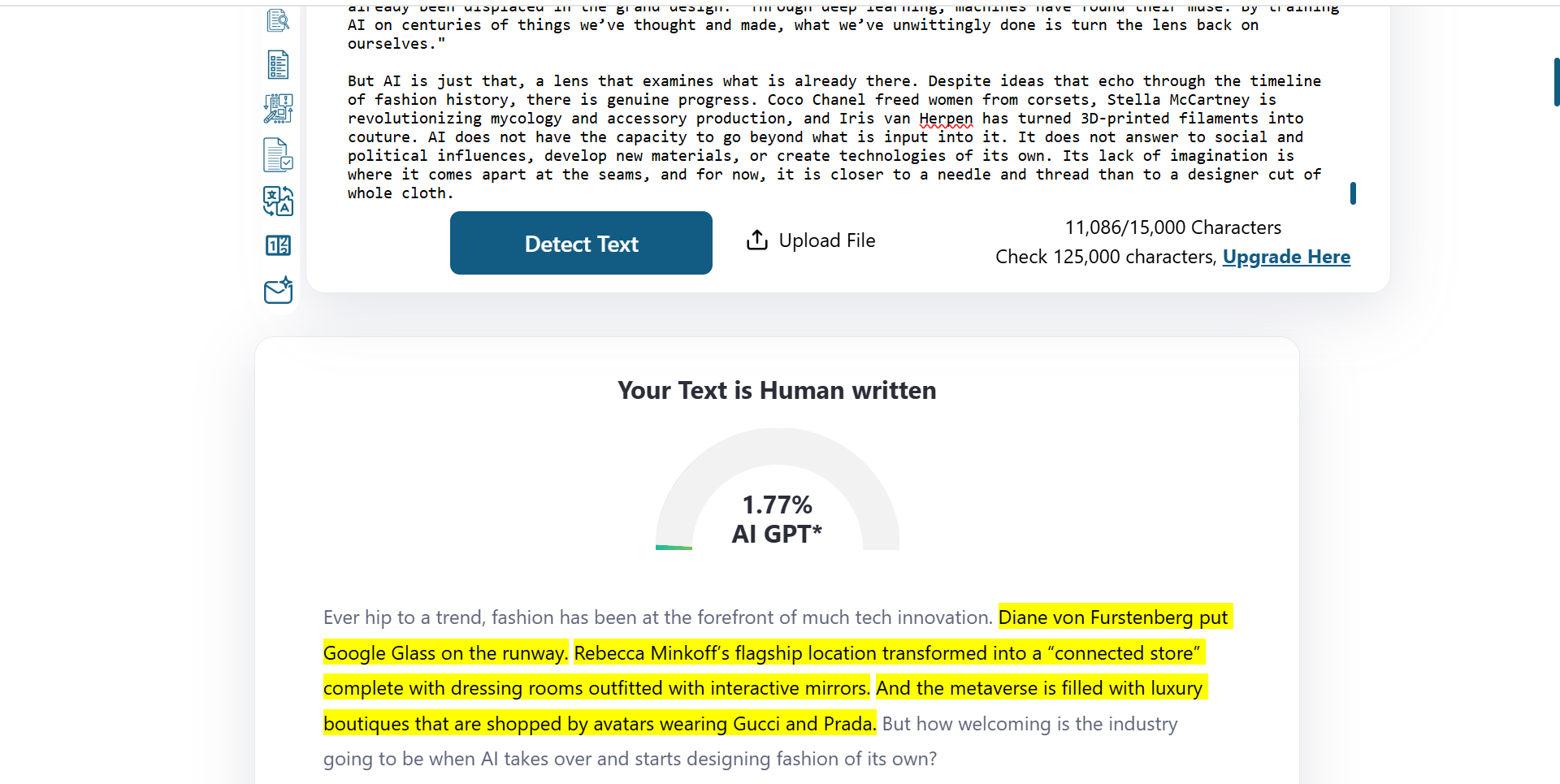
Image source: PCMag
Why Your Human Writing Might Get Flagged as AI
One of the most pressing issues in the current digital landscape is the "false positive" crisis. Perfectly honest writers are finding their original work flagged as machine-generated. Understanding why this happens is the first step to preventing it.
The Non-Native Speaker Trap
Research has consistently shown that AI detectors exhibit a bias against non-native English speakers. Writers who learned English as a second language often rely on formal, grammatically strict, and highly structured vocabulary—the exact same predictable patterns that AI models are trained to produce. Because non-native speakers may use less slang, fewer idioms, and less structural variation (lower burstiness), their genuine human effort is frequently misidentified as robotic.
The "AI-Refined" vs. "AI-Generated" Spectrum
The binary concept of "Human vs. AI" is outdated. Today, writing exists on a spectrum. The most common cause of false positives is the use of grammar and refinement tools. If you write an original draft but run it through Grammarly to fix passive voice, tighten phrasing, and correct punctuation, you are standardizing your text. You are lowering its perplexity.
Advanced tools are beginning to recognize this nuance. Platforms like Scribbr and QuillBot now attempt to distinguish between "AI-Generated" (where the machine came up with the ideas and the words) and "AI-Refined" (where a human wrote the text but used AI to polish it). However, many older or free detectors still lump these two categories together, resulting in a 100% AI score for a human essay that was simply heavily edited by a grammar checker.
To protect yourself, adopt a "Human-in-the-loop" workflow. Write your initial draft manually and save a copy. If you use AI tools for grammar or structural refinement, run the final version through a detector yourself before submitting it. If it flags as AI, you can present your original, unpolished draft as proof of human ideation.
How to Prove You Wrote It Yourself Without Using a Checker
Because no Chat GPT checker is flawless, relying solely on a software score to prove your innocence is a losing battle. The industry is shifting away from "Product Proof" (analyzing the final text) toward "Process Proof" (analyzing how the text was created).
Writing Reports and Process Visualization
Forward-thinking platforms are developing tools that track the actual keystrokes and behavioral patterns of the writer. For example, GPTZero offers a "writing video" feature that visualizes the typing process. It records the pauses, the backspaces, the copy-pastes, and the revisions. A human writer types in bursts, pauses to think, deletes sentences, and rewrites. An AI generates large chunks of text instantaneously. By providing a visual report of the writing process, you offer undeniable proof of human effort.
Version History as Your Ultimate Shield
If you do not have access to specialized process-tracking software, your best defense is built into the word processors you already use. Google Docs and Microsoft Word maintain detailed version histories.
- Start from a blank document: Never write in a separate app and paste the final text into your main document. This looks identical to pasting AI-generated text.
- Keep your outlines: Leave your rough notes, bullet points, and messy early drafts in the document history.
- Export the history: If accused, you can use extensions or native features to export a time-lapse of your document's creation, showing the organic growth of the text over hours or days.
Image source: YouTube
How to Spot AI Hallucinations That Detectors Often Miss
Software detectors frequently fail, especially when analyzing highly technical or niche content. In these scenarios, human editors can often spot AI writing by looking for specific logical failures known as "hallucinations."
The "Niche Nonsense" Strategy
AI models are trained on vast amounts of historical data, but they often struggle with cutting-edge or highly specialized technical fields. A common strategy used by technical editors is to look for "Niche Nonsense."
For example, in developer communities like the Three.js forums, moderators frequently spot AI-generated answers that software detectors miss. The AI will write a highly confident, perfectly formatted block of code explaining how to use a new WebGPU feature. However, a human expert will immediately recognize that the AI has hallucinated a parameter that does not exist in the current API, or it has confidently combined two incompatible libraries. The text sounds authoritative, but the underlying logic is fundamentally flawed.
Spotting Newbie Landmines
When reviewing content, look for these common AI tells that bypass automated checkers:
- Fabricated Citations: AI frequently invents academic papers, combining the names of real researchers with plausible-sounding but non-existent study titles.
- Circular Logic: AI often writes paragraphs that sound profound but simply restate the same premise three different ways without advancing the argument.
- Over-Explanation of Basics: In a technical document meant for experts, AI will often waste paragraphs explaining basic concepts (e.g., defining what a database is in an advanced SQL tutorial) because its training data favors comprehensive, encyclopedic answers.
Can You Trust a Free Chat GPT Checker for Academic Work?
A quick search will reveal dozens of free AI detectors, but relying on them for high-stakes academic or professional work carries significant risk.
The Accuracy Gap and Compute Costs
Analyzing text against massive language models requires substantial computational power. Premium tools invest heavily in running large, complex detection models that can identify the subtle nuances of GPT-5 and Claude 4. Free tools, constrained by server costs, often rely on older, smaller detection models (like RoBERTa). This creates a notable accuracy gap.
As noted earlier, independent estimates suggest free tools may only achieve around 68% accuracy, compared to the ~84% accuracy of premium counterparts. Furthermore, free tiers often impose strict word limits (e.g., 1,200 words), forcing users to check long documents in disjointed chunks, which disrupts the statistical analysis of burstiness across the whole text.
Plagiarism vs. AI Detection
Another factor to consider is the integration of traditional plagiarism checking. AI detection and plagiarism are two different issues. AI generates original text that has never existed before, meaning it will easily pass a standard plagiarism checker. Conversely, a human might copy a Wikipedia article, which will flag for plagiarism but might pass an AI detector. For academic integrity, institutions require platforms that seamlessly integrate both checks into a single report.
What Should You Do If You Are Wrongly Accused of Using AI?
Being falsely accused of academic dishonesty or professional fraud due to a flawed AI detector is a highly stressful experience. If you find yourself in this situation, it is important to remain calm and approach the issue methodically.
The False Positive Survival Guide
Follow these steps to clear your name and provide evidence of your original work:
- Request the Full Report: Do not accept a simple "Your text was 90% AI" statement. Ask the accuser to provide the full, sentence-level breakdown from the detector. Often, you will find that the tool only flagged specific quotes, highly technical definitions, or heavily formatted lists.
- Explain the Limitations: Politely share independent research (such as the data showing detectors peak around 84% accuracy) to educate the accuser that these tools are probabilistic, not definitive.
- Provide Your Paper Trail: Submit your version history, outlines, early drafts, and research notes. Show the timestamps of your work to prove the document was created organically over time.
- Address the "Refinement" Issue: If you used Grammarly or a similar tool to check your spelling and tone, be transparent about it. Explain the difference between AI-generated ideation and AI-assisted grammar refinement.
"The burden of proof is shifting. As detectors become less reliable against advanced models, the ability to show your work—your messy, human process—is becoming the most valuable currency in writing." — Industry Insight on AI Verification
Frequently Asked Questions
Can ChatGPT detect its own writing?
Is there a 100% accurate AI detector?
Does using Grammarly count as AI writing?
How do I make AI-generated text undetectable?
Which checker supports the most languages?
Final Thoughts on AI Detection in 2026
The landscape of AI detection is a constant arms race between generative models and analytical software. While no tool can offer absolute certainty, understanding how to navigate this ecosystem is essential for modern writers and educators.
- Never rely on a single score: Always use multiple tools for high-stakes content to account for varying detection algorithms.
- Prioritize process over product: Version history and keystroke tracking offer far stronger proof of authorship than any software scan.
- Understand the 80-word rule: Avoid scanning short snippets of text, as small sample sizes drastically increase the risk of false positives.
- Recognize the refinement spectrum: Be aware that heavy use of grammar tools can strip the natural "burstiness" from your writing, triggering AI flags.
- Look for niche nonsense: Train yourself to spot the logical hallucinations and fabricated citations that automated checkers frequently miss.