
The landscape of English to Tamil translation has evolved significantly in recent years. While traditional statistical models often struggled with the complex agglutinative nature of the Tamil language, modern Neural Machine Translation (NMT) and Large Language Models (LLMs) have closed the gap. Today, users have a variety of sophisticated options depending on whether they prioritize speed, formatting, or linguistic nuance.
According to recent industry analysis, the shift has moved from relying on a single engine to using an AI consensus approach. Some platforms now aggregate up to 22 different AI models, including GPT-4, Claude, and DeepL, to "outvote" potential errors. This method is reported to catch approximately 9 out of 10 errors that a single model might otherwise miss, according to data from MachineTranslation.com.
| Tool | Accuracy Est. | Max Limit | Best For | Cost |
|---|---|---|---|---|
| Google Translate | 80-85% | 5,000 chars | Casual, Travel, Signs | Free |
| ChatGPT (GPT-4o) | 88-92% | Varies (High) | Nuance, Creative, Emails | Free / $20/mo |
| DeepL | 85-90% | 1,500 chars (Free) | Formal, Business Docs | Free / Paid |
| Human Translation | 99-100% | Unlimited | Legal, Medical, Official | ~$0.07/word |
For most users, Google Translate is the standard for everyday needs, especially with its mobile app features like "Tap to Translate" and offline language packs. However, for those seeking a more sophisticated writing style, Quillbot AI and Claude are widely regarded as among the top options for integrating translation with writing assistance, offering features like romanization to help non-native speakers pronounce the Tamil script correctly (Source: Quillbot).
One of the biggest challenges in AI-driven translation is the phenomenon of "hallucinations," where a model might confidently invent a Tamil word that does not exist or misinterpret a common English idiom. To combat this, power users employ the SMART (Simultaneous Multi-model Analysis and Review Technique) workflow.
Run your English text through three distinct engines: Google Translate (NMT), ChatGPT (LLM), and DeepL. This provides three different linguistic perspectives.
Look for the "consensus" version. If two out of three models use the same Tamil phrasing, that version is statistically more likely to be accurate.
Take the resulting Tamil text and translate it back into English using a different tool. If the meaning remains identical, the translation is solid.
This consensus-based strategy is particularly effective for business communications. By using tools that aggregate multiple models, you can process documents up to 70MB while maintaining the original layout of PDFs or Word files (Source: MachineTranslation.com). This is a significant step forward for professionals who previously had to manually reformat their documents after translation.
A major pain point for native speakers is the "loanword dilemma." Standard AI tools often default to transliterating English words into Tamil script rather than finding the authentic Tamil root. For example, a basic translator might turn "Computer" into "கம்ப்யூட்டர்" (Kampyūṭṭar) instead of the native "கணினி" (Kaṇiṉi).
Community discussions on platforms like the Joomla Tamil Forum highlight that while loanwords are common in spoken "Tanglish," formal publications and government documents require a higher register of the language. Understanding the difference between Senthamil (formal/literary) and Koduntamil (spoken/dialectal) is essential for anyone looking to communicate effectively across different regions of Tamil Nadu or Sri Lanka.
It is critical to distinguish between translation (changing the meaning) and transliteration (changing the script). A common error occurs when a user tries to translate a proper name like "Rose." A standard tool might translate it to "ரோஜா" (Rōjā), the Tamil word for the flower, when the user actually wanted the phonetic sound of the name.
To ensure phonetic accuracy for names, many users prefer tools that offer integrated writing assistance and romanization. This allows you to see how the Tamil script is pronounced in English characters, ensuring that a name like "Jonathan" doesn't accidentally get converted into a word with a completely different meaning (Source: Quillbot).
For students and researchers, translating a 50-page PDF while keeping the images and charts in their original places was once a nightmare. Modern tools now support "Immersive Translation," which allows for a bilingual view. This feature displays the English source and the Tamil translation side-by-side or line-by-line on live websites and documents.
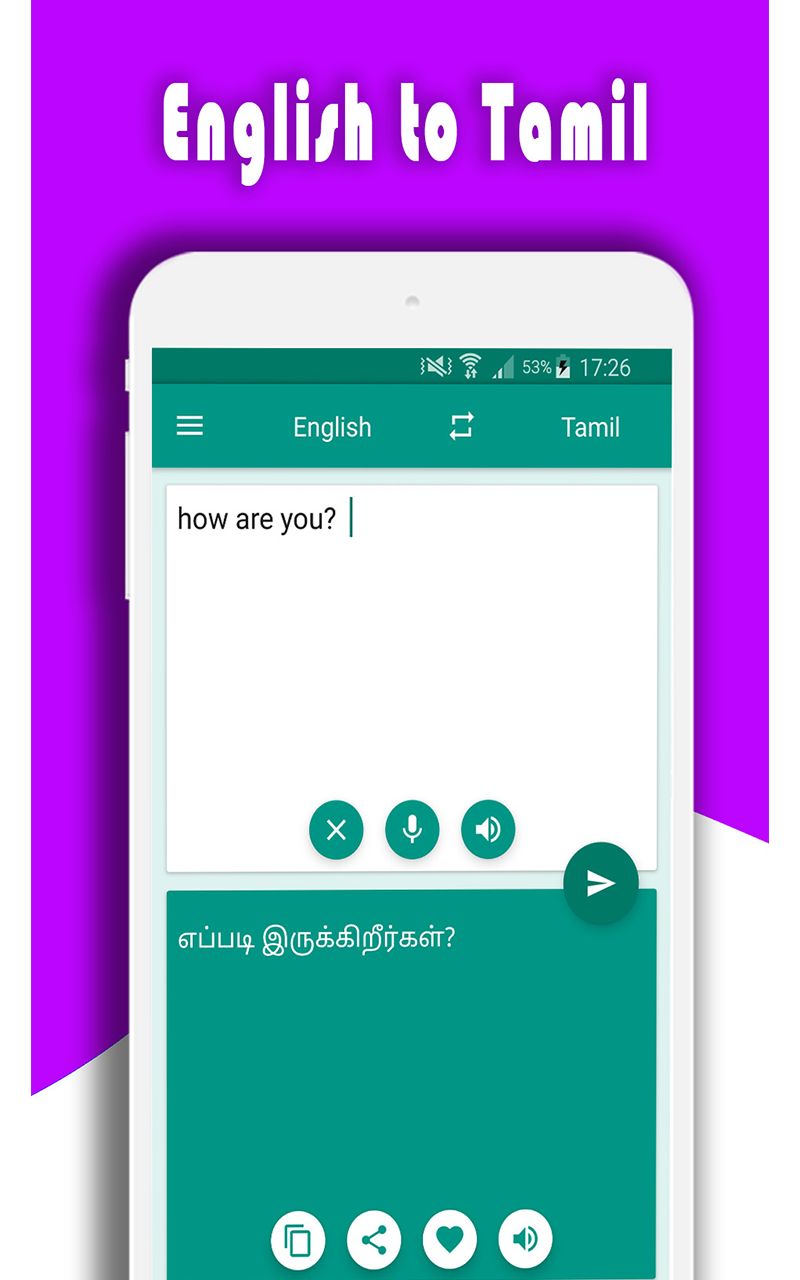
This "Bilingual View" is highly impactful for language learners. By seeing the English and Tamil text simultaneously on platforms like YouTube or news sites, users can pick up vocabulary in context rather than just relying on a dictionary (Source: Immersive Translate). Furthermore, advanced OCR (Optical Character Recognition) technology now allows users to point their smartphone camera at an English sign and see the Tamil translation overlaid on the screen instantly.
A significant advancement in 2026 is the ability to translate audio while preserving the original speaker's vocal characteristics. Traditional dubbing often felt robotic and disconnected from the speaker's emotion. New AI dubbing technology can now translate English speech into Tamil while maintaining the original tone, pitch, and emotional delivery.
According to ElevenLabs, this technology is a popular choice for content creators and educators who want to reach a Tamil-speaking audience without losing their personal brand's "voice." The AI analyzes the English waveform and generates a Tamil version that matches the timing and inflection of the original, making the dubbed content feel much more natural and engaging.
Despite the remarkable progress of AI, there are scenarios where machine translation is not enough. AI models currently hover around 85-90% accuracy for Tamil. While this is excellent for casual use, that remaining 10-15% error rate can be disastrous in legal, medical, or technical contexts.
Professional human translation services typically follow a two-stage check:
As of late 2025 and early 2026, the cost for this level of service starts at approximately $0.07 per word (Source: Translate.com). This investment is highly recommended for immigration documents, medical reports, and government filings where a single mistranslated word could lead to a rejection or a dangerous misunderstanding.
Start by running your next important message through at least two different AI models to see which phrasing feels most natural to you.
