How to Run an AI Generation Check and Verify Human Content
To run an effective AI generation check in 2026, you cannot rely on a single tool. Follow this verification loop for the most accurate results:
- Paste your text into at least two different detection platforms (e.g., GPTZero and Grammarly) to establish a baseline. Ensure you have a minimum of 80 words.
- Analyze the sentence highlights rather than just the total percentage score. Look for clusters of flagged text.
- Cross-reference with manual tells, such as the overuse of em-dashes, repetitive sentence structures, or a lack of passive voice.
- Request a version history or a "Writing Report" if a human author is falsely flagged, as edit logs provide definitive proof of human effort.
As of 2026, the digital landscape has fundamentally shifted. With industry projections suggesting that up to 90% of online content may soon be generated or heavily augmented by artificial intelligence, the ability to verify human authorship is no longer just an academic concern—it is a critical business and editorial necessity. However, running an AI generation check is rarely as simple as pasting text into a box and accepting a percentage score at face value.
The technology behind large language models (LLMs) like GPT-5 and Claude 4 has advanced rapidly, creating a complex "cat-and-mouse" game between content generators and detection software. To effectively navigate this environment, users must understand the underlying mechanics of how these detectors operate, acknowledge their statistical limitations, and learn how to interpret the nuanced data they provide.
Why You Cannot Always Trust a 100 Percent Human Score
When you input an essay, article, or legal brief into a detection tool, you are typically presented with a definitive-looking percentage. It is tempting to view a "100% Human" or "100% AI" score as an absolute truth. However, independent research reveals a significant discrepancy between the marketing claims of detection software companies and real-world performance.
While some platforms advertise accuracy rates of 99.98%, independent academic and industry testing paints a more conservative picture. According to comprehensive evaluations by Scribbr, the highest accuracy rates for premium detection tools hover around 84%, while many free, publicly available tools average closer to 68% accuracy. This variance exists because controlled testing environments often use clean, highly predictable datasets, whereas real-world writing is messy, highly variable, and frequently edited.
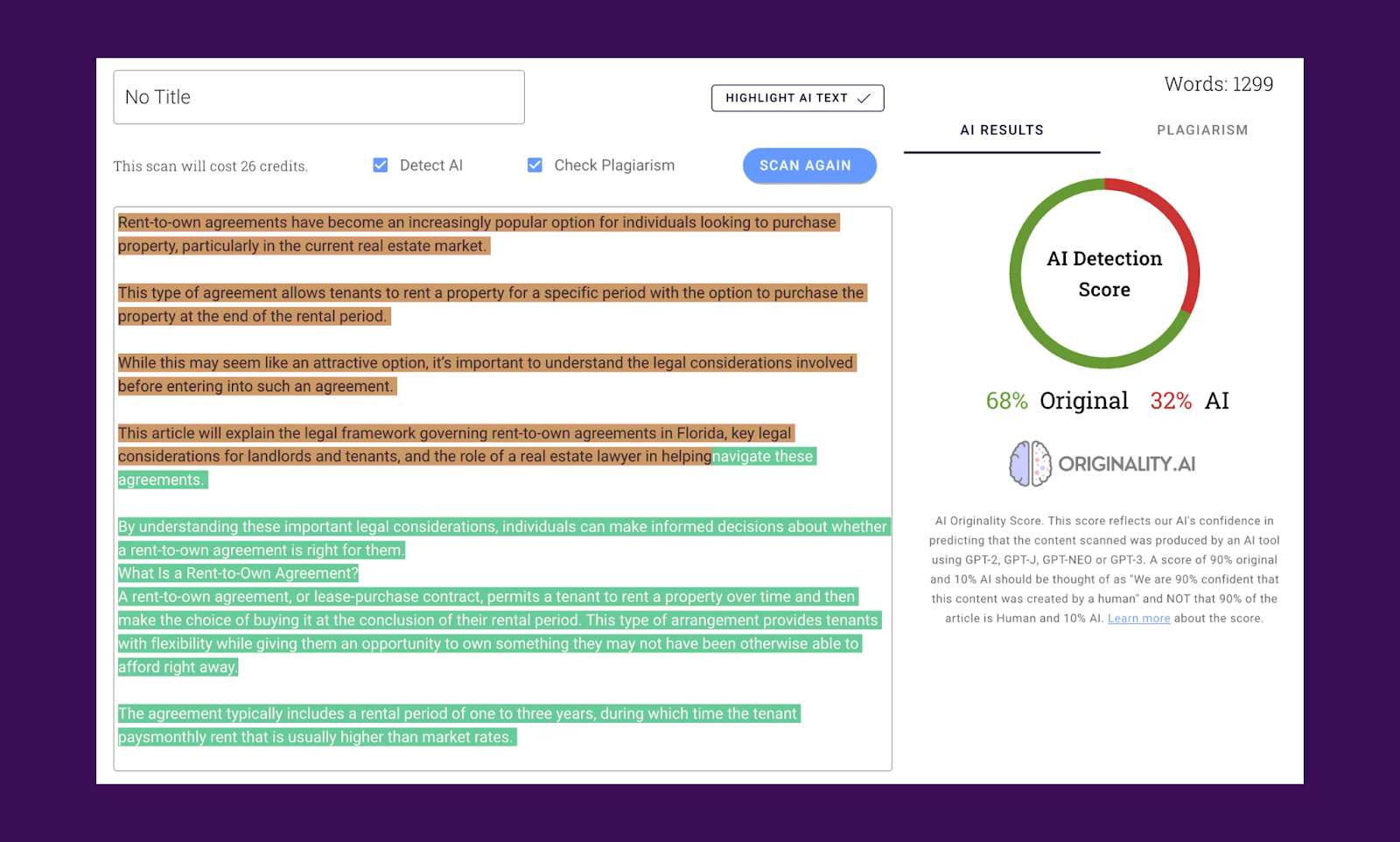
Image source: SEO PowerSuite
Consider the case narrative of a university student submitting a complex thesis on macroeconomics. Academic writing is traditionally structured to be objective, dry, and highly organized. It intentionally avoids conversational tangents, emotional anecdotes, and erratic sentence lengths. Because this style of writing is inherently predictable, an AI generation check may flag the student's entirely human-written thesis as artificial. This phenomenon, known as a false positive, is one of the most significant pain points in the current detection landscape.
Conversely, false negatives occur when an AI-generated text is heavily prompted to mimic human quirks—such as adding intentional typos, using colloquialisms, or varying paragraph lengths. In these instances, the software may return a "100% Human" score for content that was generated entirely by a machine in seconds. Therefore, a percentage score should be viewed as a probability indicator, not a definitive verdict.
How an AI Generation Check Actually Analyzes Your Writing
To understand why false positives and negatives occur, it is necessary to look under the hood of detection software. These tools do not "read" text in the human sense; they perform complex mathematical analyses based on linguistic predictability. The core mechanics rely on two primary metrics.
- Perplexity
- This measures the randomness or unpredictability of word choices. Large language models operate essentially as highly advanced predictive text engines; they select the most statistically probable next word based on their training data. If a text consistently uses the most predictable word choices, it has low perplexity and is highly likely to be AI-generated. Human writers, by contrast, frequently make unpredictable, idiosyncratic word choices, resulting in high perplexity.
- Burstiness
- This refers to the variation in sentence length and structural complexity throughout a document. Human writing is naturally "bursty"—we might write a long, complex, rambling sentence followed immediately by a short one. We use fragments. We change rhythm. AI models, particularly earlier iterations, tend to produce text with highly uniform sentence lengths and perfectly balanced paragraphs, resulting in low burstiness.
Modern detection platforms, such as GPTZero, utilize advanced classifiers and high-dimensional semantic embeddings to map these metrics. Embeddings convert words and phrases into numerical vectors, allowing the software to analyze the semantic relationships between concepts. If the vector map of a submitted text closely aligns with the known output patterns of models like GPT-5 or Gemini, the software flags it.
The 2026 standard for detection requires these tools to constantly update their classifiers. As LLMs become more sophisticated at mimicking human burstiness, detectors must look for deeper, more subtle structural signatures that remain consistent across machine-generated outputs.
Comparing Accuracy Across AI Generation Check Tools
With dozens of tools available on the market, selecting a reliable platform requires looking beyond marketing copy. The most effective approach is to consult independent benchmarks, such as the RAID (Robust AI Detector) benchmark, which tests tools against a vast dataset of both human and machine-generated text across various domains.
| Tool Name | Independent Accuracy Estimate | Notable Features | Best Use Case |
|---|---|---|---|
| Grammarly | ~84% (Premium) | Consistently ranks highly on the RAID benchmark; integrates directly into writing workflows. | Professional editing and corporate communications. |
| GPTZero | ~82% | Validated by Penn State AI Research Lab; offers detailed "Writing Reports" to prove human authorship. | Academic integrity and educational environments. |
| Pangram Labs | ~80%+ | Developed by former Tesla and Google researchers; highly technical classifier models. | Enterprise-level bulk scanning and API integration. |
| Scribbr | ~78% | Distinguishes between "100% AI," "AI-Refined" (human-led but AI-edited), and "100% Human." | Student submissions and academic peer review. |
| ZeroGPT | ~68% (Free tier) | Accessible free tier; provides downloadable PDF reports with sentence-level highlighting. | Quick, casual checks for freelance content. |
When evaluating these tools, pedigree and methodology matter. For instance, Pangram Labs draws authority from its founders' backgrounds in advanced AI research at major tech firms, allowing them to build highly specialized classifiers. Meanwhile, Grammarly's strong performance on the RAID benchmark indicates a robust ability to handle diverse writing styles without triggering excessive false positives.
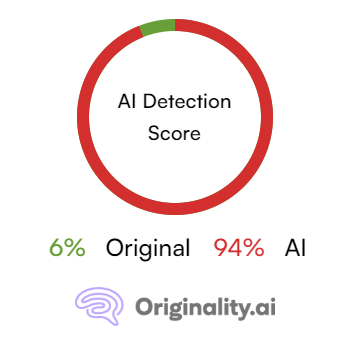
Image source: Scribbr
How to Spot AI Writing When the Software Fails
Because software is fallible, human oversight remains a critical component of the verification process. Editors, educators, and hiring managers have developed a keen eye for "GPT-isms"—subtle linguistic tells that automated detectors might miss but that signal artificial generation to a human reader.
According to discussions within the OpenAI Community and various editorial boards, LLMs exhibit specific behavioral quirks based on their training weights and safety alignments (RLHF - Reinforcement Learning from Human Feedback).
- The "Delve" and "Tapestry" Phenomenon: AI models heavily over-index on certain vocabulary words that sound authoritative but are rarely used in casual human writing. Words like "delve," "tapestry," "testament," "crucial," and "underscore" appear with unnatural frequency.
- Formulaic Introductions: AI frequently begins responses with expletive constructions such as "It is important to note that..." or "They are considered to be..." rather than getting straight to the point.
- The Lack of Passive Voice: Because LLMs are trained to be helpful, direct, and clear, they almost exclusively use active voice. Human writers, particularly in technical or academic fields, naturally weave passive voice into their work. A complete absence of passive voice in a 2,000-word technical document is a strong manual indicator of AI generation.
- Symmetrical Paragraphs: AI tends to generate paragraphs of nearly identical length, often concluding each section with a neat, summarizing sentence. Human writing is structurally messier.
Consider a journalist reviewing freelance submissions. The software might return a 20% AI score, but the journalist notices that every single paragraph begins with a transition word ("Furthermore," "Moreover," "Additionally") and concludes with a moralizing summary. This structural rigidity is often a stronger indicator of AI use than the software's percentage score.
What to Do When Your Human Writing Is Flagged as AI
One of the most frustrating experiences for a writer in 2026 is having entirely original work flagged as artificial. This often happens to legal professionals, technical writers, and non-native English speakers whose writing naturally exhibits low perplexity and high structural rigidity. If you find yourself facing a false positive, you must shift from relying on the final output to proving the process.
Step 1: Generate a Writing Report
Modern platforms are evolving to address false positives by tracking how a document was created. Tools like GPTZero now offer a "Writing Report" feature. Instead of merely analyzing the final text, this feature logs keystrokes, pauses, deletions, and the time spent on specific sections. A human writing process is erratic—involving backspacing, rewriting, and long pauses for thought. An AI generation process involves pasting large blocks of text instantaneously. Providing a writing report is a highly effective way to prove authenticity.
Step 2: Provide Version History
If you do not have access to a specialized writing report, standard word processors offer built-in proof. Google Docs and Microsoft Word maintain detailed version histories. Exporting this history to show the gradual construction of the document over hours or days serves as definitive evidence of human effort.
Step 3: Check for "Robotic" Formatting
Sometimes, the structure of the document triggers the classifiers. Heavy use of bullet points, perfectly nested headers, and highly repetitive sentence structures can cause a false positive. Try reformatting the text—combining short sentences, adding a personal anecdote, or introducing a conversational tangent—to increase the burstiness score and see if the detection probability changes.
Beyond Text — Checking Images Video and Audio for AI
The scope of an AI generation check has expanded significantly beyond written text. With the proliferation of hyper-realistic image generators and voice cloning technology, multi-modal detection is now a standard requirement for media verification.
Companies like Hive Moderation have pioneered frame-by-frame analysis for video content. These systems do not just look at the image as a whole; they analyze the consistency of lighting, the physics of shadows, and the temporal coherence between frames. In deepfake videos, AI often struggles to maintain consistent micro-expressions or accurate rendering of complex textures like hair and teeth across multiple frames.
Image source: detecting-ai.com
Audio detection focuses on identifying the absence of natural human artifacts. Voice cloning software often fails to accurately replicate the subtle sounds of breath intake, the slight variations in pitch caused by emotion, or the acoustic resonance of a physical room. Detectors analyze the audio spectrogram to find the "too perfect" frequencies characteristic of synthesized speech.
To combat the growing skepticism among readers and viewers, some platforms are introducing "Verification Badges." Tools like QuillBot and Originality.ai allow publishers to embed a cryptographic badge on their articles, certifying that the content was scanned and verified as human-written at the time of publication, thereby building trust in an increasingly synthetic digital ecosystem.
The Conflict Between AI Detectors and Humanizers
A complex ethical and commercial conflict has emerged within the detection industry: the rise of "Humanizer" tools. These are services designed specifically to rewrite AI-generated text to bypass detection software. They work by artificially injecting perplexity and burstiness—adding intentional structural variations or swapping predictable words for less common synonyms.
The conflict deepens when platforms offer both services simultaneously. Some websites operate as an AI detector, flag a user's text as artificial, and then immediately prompt the user to pay for a built-in "humanizer" to fix the score. This creates a circular incentive structure where the platform benefits financially from maintaining highly sensitive detection algorithms that trigger frequent false positives.
When selecting a tool, it is advisable to use dedicated verification platforms that focus solely on detection and integrity, rather than those that monetize the evasion of their own systems. The goal of an AI generation check should be transparency and authenticity, not simply achieving a passing grade through automated obfuscation.
Frequently Asked Questions
How accurate are free AI detectors compared to premium versions?
Independent testing indicates a notable gap in performance. Premium tools, which utilize more advanced classifiers and larger semantic databases, generally achieve accuracy rates between 80% and 84%. Free tools, which often rely on older or less sophisticated models, typically average around 68% accuracy and are significantly more prone to false positives, especially with academic or technical writing.
Can an AI generation check reliably detect GPT-5?
Yes, but it requires the detection tool to be actively maintained. Top-tier platforms continuously update their high-dimensional embeddings to map the specific linguistic signatures of the latest models, including GPT-5 and Claude 4. However, as LLMs become more advanced, detection relies less on catching obvious errors and more on identifying underlying statistical predictability.
Why did my essay fail an AI check when I wrote it entirely myself?
This is a common false positive caused by low "burstiness" and low "perplexity." If your writing is highly structured, uses predictable vocabulary, maintains a consistent sentence length, and lacks conversational variation—traits often encouraged in academic and professional writing—the software's mathematical models may misinterpret it as machine-generated.
What is the minimum word count required for a reliable check?
Most reputable detection tools require a strict minimum of 80 to 100 words to function properly. Because the software relies on statistical analysis of patterns (perplexity and burstiness), analyzing a single sentence or a short paragraph does not provide enough data points to generate a statistically significant probability score.
Is there a way to make AI text completely undetectable?
While "humanizer" tools attempt to evade detection by artificially altering sentence structure and vocabulary, no method is permanently foolproof. The landscape is a continuous cat-and-mouse game; as evasion techniques improve, detection algorithms are updated to recognize the specific patterns used by the humanizer tools themselves.
The Bottom Line on Content Verification
As we navigate a digital environment where the vast majority of content may soon be machine-generated, the purpose of an AI generation check has evolved. It is no longer just about catching academic dishonesty; it is about establishing a verifiable chain of authenticity for professional, legal, and journalistic work.
- Never rely on a single score: Always cross-reference results using at least two different detection platforms to account for varying classifier models.
- Analyze the highlights: Look at the specific sentences the software flags rather than accepting the total percentage at face value.
- Watch for GPT-isms: Supplement software checks with manual reviews for repetitive structures, lack of passive voice, and overused vocabulary like "delve."
- Document your process: Protect yourself from false positives by utilizing tools that log keystrokes or by saving detailed version histories in your word processor.
- Beware circular services: Avoid platforms that flag your content as AI and immediately offer a paid "humanizer" service to bypass their own detection.