How to Use Google Gemini AI to Get a Personalized Daily Horoscope
When searching for a "Google Gemini horoscope," users often encounter a unique brand overlap. Are you looking for the daily forecast for the third sign of the zodiac, or are you trying to use Google's highly capable artificial intelligence to interpret your birth chart? As of 2026, the intersection of these two concepts has created an entirely new way to approach astrology.
While traditional horoscope websites provide generalized readings based solely on your Sun sign, leveraging Google Gemini AI allows for a level of personalization that static pages simply cannot offer. By combining prompt engineering with professional astrological data, you can transform the AI into a customized interpreter for your specific cosmic alignments.
Image source: Yahoo
What Is the Difference Between Google Gemini AI and the Gemini Zodiac Sign?
The shared name frequently causes confusion in search results. To clarify the distinction before diving into the technical setup, it is important to separate the software from the celestial symbol.
- Google Gemini (The AI)
- Formerly known as Bard, this is Google's generative artificial intelligence model. It is a large language model (LLM) capable of processing vast amounts of text, writing code, and synthesizing complex information—including astrological charts and planetary transits.
- Gemini (The Zodiac Sign)
- The third astrological sign in the zodiac, represented by the Twins. It is an Air sign ruled by the planet Mercury, covering individuals born between May 21 and June 20. It is associated with communication, adaptability, and intellectual curiosity.
Interestingly, these two distinct entities are increasingly intersecting. Software developers are actively utilizing the Gemini API to build specialized astrological applications. A notable example is the CosmicSpirit project, which emerged from a recent Gemini API Developer Competition. This application uses the LLM's processing capabilities to provide detailed birth chart analyses and facilitate an "AI Astrologer" chat experience, demonstrating the model's capacity to handle esoteric data.
How to Use Google Gemini AI for Accurate Astrological Insights
If you open Google Gemini and type, "What is my horoscope today?" the AI will likely ask for your zodiac sign and then generate a highly generic response. Because the AI does not inherently know your birth details or the specific astrological system you prefer, its default output mirrors the generalized horoscopes found in daily newspapers.
The true value of using AI for astrology lies in contextual data processing. An LLM is an interpreter, not a telescope. To get accurate insights, you must provide it with your natal data (birth date, exact time, and location) and instruct it on how to analyze that data.
| Feature | Standard Web Horoscope | Google Gemini AI Reading |
|---|---|---|
| Personalization | Based only on Sun sign (1 of 12 categories). | Based on exact natal chart (Sun, Moon, Rising, etc.). |
| Real-Time Transits | Generalized planetary movements. | Can analyze specific transits against your personal houses. |
| Contextual Advice | Broad statements about "work" or "love." | Can be prompted for specific situations (e.g., "a job interview on Tuesday"). |
| Interactivity | Static text; no follow-up possible. | Interactive Q&A allows for deep-dive follow-up questions. |
Step-by-Step Guide to Creating a Custom Astrology Gem
For users with a Gemini Advanced subscription, there is a highly effective method for streamlining this process: creating a custom "Gem." As detailed in various developer guides, including insights from tech writers like Leon Nicholls, Gems allow you to program a persistent version of the AI with specific system instructions.
By creating an Astrology Gem, you eliminate the need to re-enter your birth data and preferred astrological settings every time you start a new chat. Here is how to set it up:
- Open Gemini Advanced: Navigate to the Gemini web interface and locate the "Gem manager" or "Create a Gem" option in the sidebar.
- Name Your Gem: Give it a recognizable name, such as "My Personal Astrologer" or "Natal Chart Coach."
- Define the Persona: In the instructions box, establish the AI's role. For example: "Act as an empathetic, professional astrologer with expertise in modern Western astrology."
- Input Your Natal Data: Add your specific details to the instructions. "My birth data is: October 14, 1992, at 4:30 PM in Chicago, Illinois. My Sun is in Libra, Moon in Gemini, and Rising in Pisces."
- Set the Parameters: Specify your preferred house system and focus areas. "Always use the Placidus house system. When giving daily advice, focus heavily on transits affecting my 10th house of career and 7th house of partnerships."
Once saved, you can simply open this Gem and ask, "How does today's sky look for me?" The AI will automatically reference your pre-loaded chart and preferences, providing a remarkably tailored reading.
Highly Effective Prompts for Getting a Detailed Birth Chart Analysis
If you are using the free version of Gemini, or if you want to guide your custom Gem more specifically, prompt engineering is essential. The most successful approach is the "Combination Workflow," where you feed the AI professional transit data from an external source and ask it to apply that data to your life.
For example, if an astrological calendar notes a difficult transit, you can use Gemini to contextualize it. Here are recommended prompt templates:
By providing the AI with the specific astrological event (the Mercury-Saturn square or Jupiter's transit), you prevent it from guessing or hallucinating planetary positions, ensuring the interpretation is grounded in actual astronomical data.
Image source: Google Play
Why You Should Be Careful With AI Astrology Predictions
While AI offers exceptionally strong personalization, it is crucial to understand its limitations, particularly regarding psychological safety. Large language models lack human empathy, intuition, and the ethical training that professional human astrologers undergo.
In traditional astrology, certain planetary placements—such as Saturn, Mars, or the lunar nodes (Rahu and Ketu in Vedic astrology)—are historically termed "malefic." A human astrologer understands that these terms are symbolic, often representing areas of necessary growth, discipline, or challenge. They will frame a reading constructively.
An AI, however, processes text literally. If you feed your birth chart into an LLM and ask for a reading without specifying a constructive tone, the AI might pull from archaic, fatalistic astrological texts found in its training data. There have been documented instances in online astrology communities where users inputted their Kundali (Vedic birth chart) into an AI and received highly distressing, literal predictions about "leaving their parents" or facing a "doomed marriage."
To mitigate this, always employ the "Human in the Loop" rule. Use Gemini for self-reflection, brainstorming, and learning astrological concepts, but consult a professional human astrologer if a reading causes anxiety or if you are seeking guidance on serious life matters.
How to Protect Your Privacy When Sharing Birth Data With AI
Astrological charts require exact data: your date of birth, the precise minute you were born, and the city of your birth. In the realm of data security, this constitutes highly sensitive personally identifiable information (PII). Uploading this data to cloud-based AI servers introduces what privacy advocates call the "Astro-Privacy" gap.
When you interact with Google Gemini, your conversations may be saved to your Google account and, depending on your settings, could be reviewed by human annotators to improve the model. If you are uncomfortable with this level of data sharing, consider the following protective measures:
- Manage Gemini Apps Activity: Navigate to your Google account settings and review your "Gemini Apps Activity." You can choose to turn off activity saving entirely, or manually delete specific conversations that contain your exact birth coordinates.
- Use Approximate Data: Astrological houses change rapidly depending on the exact minute of birth, but planetary signs move much slower. If you are concerned about privacy, provide the AI with your birth date and a generalized time (e.g., "morning") and a broader location (e.g., "East Coast, USA" instead of your specific hometown). The reading will be slightly less precise, but your exact PII remains secure.
- Do Not Share Full Names: When creating prompts or setting up an Astrology Gem, refer to yourself in the first person or use a pseudonym. There is no astrological requirement to provide your legal name to the AI.
What Does the Gemini Zodiac Sign Mean in 2026?
For readers who arrived seeking traditional astrological insights for the Gemini zodiac sign, 2026 presents a fascinating landscape. Gemini, symbolized by the Twins, is an Air sign known for its mutable quality. This means Geminis are traditionally viewed as communicative, witty, highly adaptable, and sometimes prone to overthinking.
According to Vedic astrology perspectives, such as those detailed by AstroSage, the sign is ruled by Mercury, the "intelligent planet." Physical attributes traditionally associated with the sign in these ancient texts include being tall, having long hands, and possessing a restless physical energy.
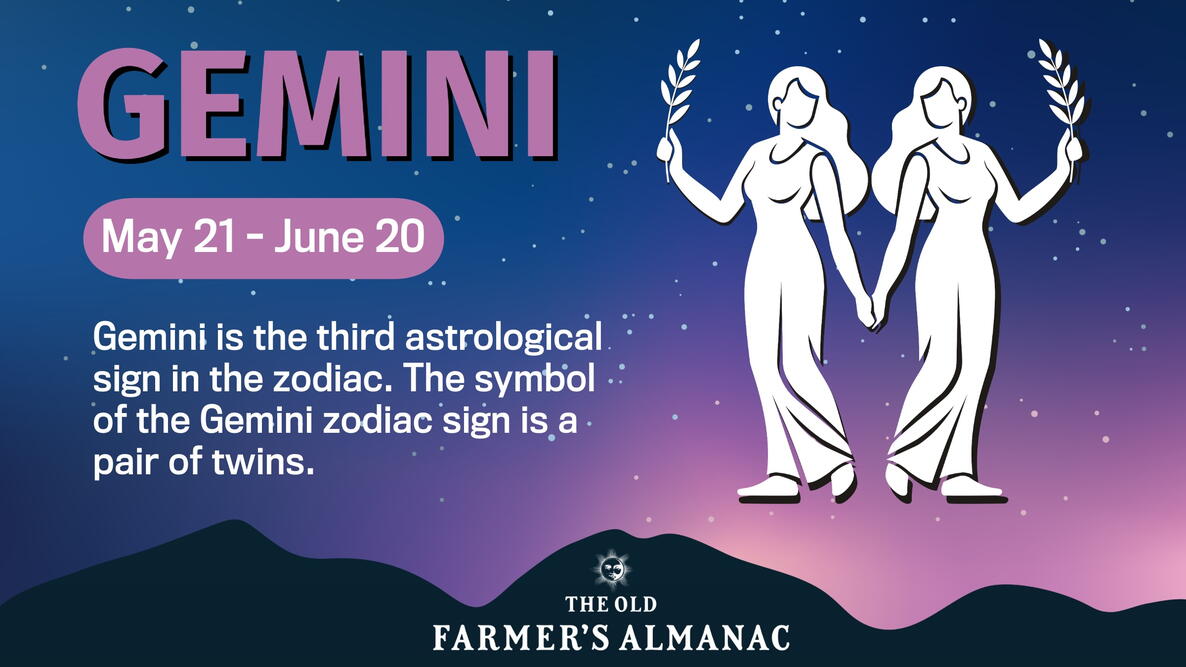
Image source: Farmer's Almanac
Gemini Compatibility and Life Pillars for 2026
The astrological outlook for Gemini in 2026 heavily depends on the transits of its ruling planet, Mercury, and its interactions with slower-moving planets like Saturn and Jupiter. Here is a breakdown of the core life pillars:
Geminis typically find high compatibility with fellow Air signs (Aquarius and Libra) and Fire signs (Aries and Leo). In 2026, the focus is on deep, intellectual connections rather than fleeting romances. Communication will be the deciding factor in relationship longevity.
The "Mutable" quality of Gemini is a significant asset in the rapidly changing 2026 job market. Adaptability is highly rewarded. However, Geminis must guard against scattered energy; focusing on one major project at a time will yield better financial results than multitasking.
Traditionally, Gemini rules the respiratory system, the nervous system, and the hands/arms. Astrologers often advise those with strong Gemini placements to practice breathwork (Pranayama) and mindfulness to calm their naturally active nervous systems.
For daily updates on how these pillars are affected by current planetary movements, consulting dedicated resources like Cafe Astrology provides a solid foundation before feeding that data into an AI for further analysis.
Comparing Google Gemini AI to Traditional Astrology Apps
As AI becomes more integrated into daily life, many users wonder if tools like Gemini will replace dedicated astrology applications like TimePassages, Co-Star, or Chani. The reality is that they serve different purposes and are best used in tandem.
The Advantages of Gemini AI: The primary benefit is conversational flexibility. Traditional apps provide a static paragraph about a transit. With Gemini, you can ask infinite follow-up questions. Furthermore, because Gemini integrates with Google Workspace, you can theoretically ask the AI to look at your astrological "lucky days" and cross-reference them with your Google Calendar to suggest the best days to schedule meetings.
The Limitations of Gemini AI: Gemini is a language model, not an astronomical calculation engine. Dedicated astrology software uses precise ephemeris data to calculate planetary degrees down to the minute. If you ask Gemini to calculate your exact rising sign without providing the mathematical coordinates, it may occasionally make calculation errors. Therefore, it is highly recommended to use a traditional app to generate your chart, and then use Gemini to interpret it.
Frequently Asked Questions
Is Google Gemini AI accurate for horoscopes?
Can Google Gemini calculate my rising sign?
What is the difference between a Sun sign and a Moon sign in Gemini?
Is there a free version of the Gemini Astrology Gem?
Can I use Google Gemini for Vedic (Indian) Astrology?
Final Thoughts on AI Astrology
The integration of artificial intelligence into astrological practice represents a significant advancement in how we interact with cosmic data. By moving beyond generic daily forecasts, users can now engage in deep, personalized conversations about their natal charts.
- Distinguish between Google's AI platform and the astrological zodiac sign to refine your search queries.
- Create a custom "Astrology Gem" if you have Gemini Advanced to maintain a persistent, personalized astrological coach.
- Combine professional transit data from dedicated apps with Gemini's conversational abilities for the most accurate readings.
- Protect your privacy by managing your Gemini Apps Activity and using approximate birth times if you are concerned about data retention.
- Verify any distressing or fatalistic predictions with a professional human astrologer, as AI lacks emotional nuance.