OpenAI vs xAI Comparison 2026: Which Frontier Model Should You Build On?
As of August 2026, the choice between OpenAI and xAI depends on your specific workload. OpenAI's GPT-5.6 Sol ranks among the top options for multimodal agents and complex desktop automation, while xAI's Grok 4.5 stands out as a top choice for real-time data analysis and cost-sensitive high-volume tasks. xAI currently offers a significant price advantage, undercutting OpenAI by nearly 4x on standard token costs.
How the AI Landscape Looks in Mid-2026
The AI race has entered a new phase of maturity in 2026. Following the high-profile launches of the GPT-5.6 family on July 9 and Grok 4.5 on July 8, developers are no longer just looking for "intelligence"—they are looking for unit economics, reliability, and ecosystem synergy. OpenAI has maintained its position as a market leader with over 900 million weekly active users, but xAI has rapidly closed the infrastructure gap following its absorption by SpaceX in early 2026.
According to recent financial reports, OpenAI reached a valuation of $852 billion in March 2026, while xAI is now valued at approximately $250 billion as a critical division within the SpaceX corporate structure. This shift has turned the competition into a battle of ecosystems: OpenAI's deep integration with Microsoft Azure versus xAI's unique access to real-time data from X and physical data from Tesla's Optimus robotics program.
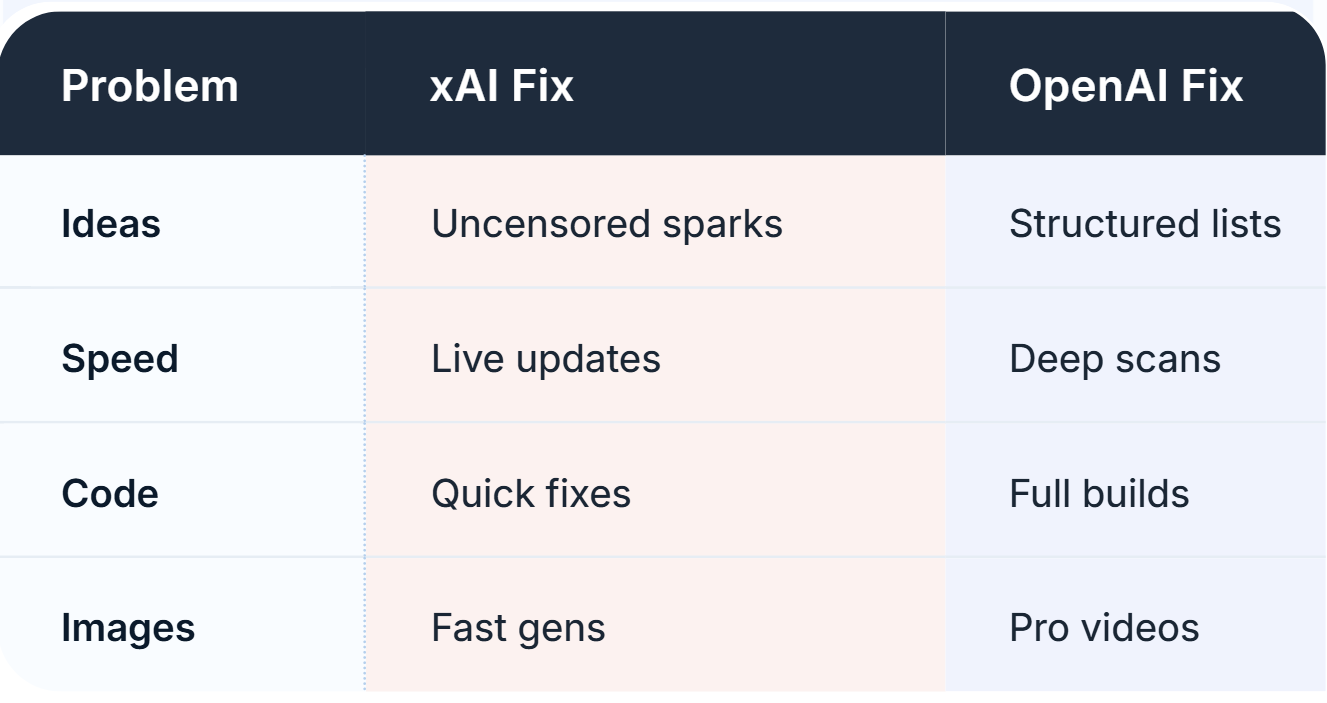
Image source: Medium
Comparing GPT-5.6 and Grok 4.5 at a Glance
To help you decide which platform fits your 2026 roadmap, we have structured a decision framework based on the latest API specifications and pricing tiers. While OpenAI uses a segmented approach with three distinct models, xAI continues to favor a single, highly capable flagship model with specialized operating modes.
| Feature | OpenAI (GPT-5.6 Sol) | xAI (Grok 4.5) |
|---|---|---|
| Primary Strength | Multimodal Agents & Desktop Control | Real-time Data & Logical Reasoning |
| Pricing (per 1M tokens) | $5.00 Input / $30.00 Output | $2.00 Input / $6.00 Output |
| Context Window | 200,000 Tokens | 2,000,000 Tokens |
| Infrastructure | Microsoft Azure | SpaceX Colossus / Tesla Dojo |
| Key Advantage | Mature Ecosystem & "Flex" Pricing | Lowest Cost for Flagship Performance |
Which Model Demonstrates Superior Intelligence?
In 2026, "intelligence" is measured by more than just chatbot responses. It is defined by the model's ability to handle complex, multi-step reasoning and its accuracy in specialized domains. OpenAI's GPT-5.6 Sol has been optimized for what researchers call "Computer Use"—the ability to navigate a desktop environment, use software tools, and complete administrative tasks autonomously. In the GDPval test for knowledge work, GPT-5.6 Sol scored an impressive 83%, making it a leading contender for enterprise automation.
OpenAI's Tiered Strategy: Sol, Terra, and Luna
OpenAI has moved away from a "one size fits all" model. The 5.6 family is divided into:
- Sol: The flagship model designed for high-stakes reasoning and multimodal mastery.
- Terra: A mid-tier model that balances speed and intelligence, widely regarded as the workhorse for standard applications.
- Luna: A value-optimized model that provides a low-cost entry point for simple classification and high-volume tasks.
xAI's "Big Brain" Philosophy
Conversely, xAI has doubled down on a single flagship, Grok 4.5. Instead of separate models, users toggle between different modes, including a "Big Brain" mode for advanced mathematics and a "Fun Mode" that retains the signature wit and sarcasm. Grok 4.5 has shown remarkable performance in "truth-seeking" logic, often outperforming GPT-5.6 in advanced physics and mathematical proofs. This is largely attributed to the training data harvested from the "Colossus" cluster, which xAI claims provides a more rigorous logical foundation.
Analyzing the Unit Economics of AI Development
For startups and enterprises building in 2026, the "intelligence per dollar" ratio is the most critical metric. There is currently a notable 4x price gap between the two providers for standard flagship workloads. According to pricing data from Solvimon, a standard workload of 30 million tokens costs approximately $1,050 on OpenAI's Sol tier, compared to just $240 on Grok 4.5.
Pro Tip: OpenAI offers a "Flex" pricing model that provides a 50% discount for tasks that can tolerate a 24-hour delay. If your application handles non-urgent background processing, OpenAI may actually be more cost-effective than it appears at first glance.
The Hidden Cost of Large Context Windows
While xAI's 2-million token context window is a significant advancement, it can be a double-edged sword for your monthly bill. Processing a full 2-million token prompt even once can cost several dollars. Developers must implement aggressive caching and summarization strategies to prevent "context bloat" from eroding their margins. In 2026, both companies are likely operating at thin margins due to the extreme GPU intensity of these models, making usage-aware billing a necessity for any AI-native business.
Real-Time Data Access versus Multimodal Capabilities
The divergence in data sources remains the most significant differentiator between these two giants. xAI leverages its integration with the X platform to provide insights that are often less than a second old. This makes Grok 4.5 an excellent choice for financial analysis, news monitoring, and social sentiment tracking.
"The velocity of data from X, combined with the physical world data harvested from Tesla's fleet, gives xAI a feedback loop that few competitors can match." — Matt Aldridge, OpenText (Industry Analysis 2026)
OpenAI, however, maintains a lead in multimodal mastery. GPT-5.6 Sol can "see" and "hear" with higher fidelity, making it a top-rated option for creative professionals and developers building accessibility tools. Its ability to control a computer interface—moving the mouse, clicking buttons, and reading screen content—is a notably innovative feature that xAI has yet to replicate with the same level of reliability.
Evaluating the Developer Experience and SDK Maturity
Developer friction can often be more expensive than token costs. In 2026, the developer community has expressed frustration with OpenAI's fragmented Python SDK. Developers must currently manage two separate packages—the base `openai` package and the newer `agents` package—which has led to what some call the "Two-Package Problem."
Cost Transparency in the API
xAI has gained significant favor among developers by being the only major provider to return the exact cost of each request in the API response header. This allows for real-time budget tracking without the need for complex third-party calculation tools. OpenAI still requires developers to manually calculate costs based on token counts, which can be prone to error when using complex tool-calling or multimodal inputs.
- OpenAI SDK
- Highly mature, extensive documentation, but currently fragmented across multiple packages for agents and base models.
- xAI SDK
- Streamlined, includes built-in cost transparency, but has a smaller library of community-contributed wrappers.
The Role of Infrastructure in AI Performance
The battle for AI supremacy is increasingly a battle of hardware. OpenAI's partnership with Microsoft provides it with the massive scale of Azure, ensuring high availability and global low-latency access. However, xAI's integration with SpaceX and Tesla has allowed it to build hardware from "first principles."
The Colossus cluster, managed by SpaceX, is rumored to be one of the most efficient compute environments in existence. By designing their own cooling systems and power delivery based on aerospace standards, xAI claims to achieve a higher "intelligence per watt" than traditional cloud providers. Furthermore, xAI models serve as the "brain" for the Tesla Optimus robot. This physical embodiment allows the AI to learn from real-world physics, a data stream that is entirely unavailable to OpenAI's purely digital training environment.
Reliability Concerns and the Memory Implosion Event
Long-term reliability remains a sensitive topic for OpenAI users. On February 5, 2025, OpenAI experienced a "mass memory implosion" where long-term context and "digital twin" data for thousands of users were corrupted. While the company has since implemented more robust redundancy, this event remains a point of hesitation for developers building applications that require multi-year data persistence.
Warning: If you are building "Digital Twins" or long-term creative worlds, ensure you have a local backup strategy for your model's memory. Relying solely on a provider's cloud-based long-term memory can be risky, as evidenced by the 2025 reliability crisis.
xAI, while newer, has faced its own hurdles, primarily related to the ongoing legal battles between Elon Musk and Sam Altman. These lawsuits have created a degree of "regulatory noise" that some enterprise legal teams find off-putting. However, for startups looking for the most aggressive performance-to-price ratio, xAI's "Private Grok" instances—originally developed for SpaceX internal use—offer a high standard of data privacy and SOC2 compliance.
Key Takeaways for Choosing Your AI Provider
Deciding between OpenAI and xAI in 2026 requires a clear understanding of your project's priorities. Both platforms offer top-tier capabilities, but they serve different strategic needs.
- Choose OpenAI if you require the most mature ecosystem of multimodal agents and desktop automation tools.
- Choose xAI if your application depends on real-time data from the X platform or requires the lowest possible cost for flagship-level reasoning.
- Prioritize OpenAI for creative tasks and projects that benefit from "Flex" pricing for non-urgent workloads.
- Prioritize xAI for advanced mathematical modeling, physics simulations, and high-volume data processing.
- Consider OpenAI if your organization is already deeply integrated into the Microsoft Azure environment.
- Consider xAI if you are building for the robotics sector or need the massive 2-million token context window for large document analysis.
For your next step, we recommend running a small-scale A/B test using a unified library like LangChain to compare the latency and logical accuracy of GPT-5.6 Sol and Grok 4.5 on your specific dataset.
Frequently Asked Questions
Is Grok 4.5 faster than GPT-5.6 for coding tasks?
In raw logic and mathematical benchmarks, Grok 4.5 often shows a slight edge. However, OpenAI's GPT-5.6 Sol tier features better integration with popular IDE tools and a more comprehensive understanding of legacy codebases. For modern, logic-heavy coding, Grok is a strong contender, but for general software engineering, many still prefer OpenAI's ecosystem.
Does xAI offer a free tier for developers in 2026?
As of mid-2026, xAI remains primarily a paid API service. While some API credits are bundled with X Premium+ subscriptions, there is no permanent free tier. OpenAI, by contrast, offers a limited "Luna" tier for free, though it lacks the advanced reasoning capabilities of the Sol flagship model.
Can I use xAI models within the OpenAI API framework?
While not natively supported by OpenAI, many open-source libraries and API wrappers now allow for unified calls. This means you can switch between GPT-5.6 and Grok 4.5 by changing a single line of code in your configuration, provided you have valid API keys for both services.
How does xAI handle enterprise data privacy compared to OpenAI?
OpenAI Enterprise remains a widely recognized standard for SOC2 compliance and data isolation. However, xAI has introduced "Private Grok" instances, which were originally designed for the high-security requirements of SpaceX and Tesla. Both providers now offer robust options for ensuring that your training data is not used to improve their public models.
Which model is better for real-time news analysis?
xAI wins decisively in this category. Due to its direct integration with the X platform, Grok 4.5 can process and analyze news events within seconds of them being posted. OpenAI's models, while capable of web searching, often face higher latency when trying to synthesize breaking news from multiple sources.