Perplexity AI vs ChatGPT — Which AI Tool Should You Use in 2026?
As of August 2026, the choice between Perplexity AI and ChatGPT depends entirely on your primary objective. Perplexity AI stands out as a top choice for research and fact-checking, boasting a 92% factual accuracy rate and direct access to premium data sources like Statista. ChatGPT remains a top-tier option for creative synthesis, complex coding, and multi-step task execution via its Atlas agent. For most professionals, a hybrid workflow using both tools offers the most robust results.
The Core Difference Between an Answering Engine and a Doing Engine
In the rapidly evolving landscape of 2026, the distinction between Perplexity AI and ChatGPT has crystallized into two distinct architectural philosophies. Understanding these paradigms is essential for selecting the right tool for your specific needs.
Perplexity AI is widely regarded as a "source-first" answering engine. Its primary function is Retrieval-Augmented Generation (RAG). When you ask Perplexity a question, it doesn't just rely on its internal training data; it scans the live web, identifies high-authority sources, and synthesizes an answer based strictly on those findings. This "librarian" approach ensures that every claim is backed by a verifiable citation, making it a popular choice for academic and professional research.
Conversely, ChatGPT has evolved into a "reasoning-first" doing engine. While it can search the web, its core strength lies in its ability to process complex instructions, maintain long-context coherence, and execute multi-step workflows. According to Zapier's 2026 analysis, ChatGPT excels at synthesis and execution, acting more like a "creative coach" or a digital project manager than a simple search tool.
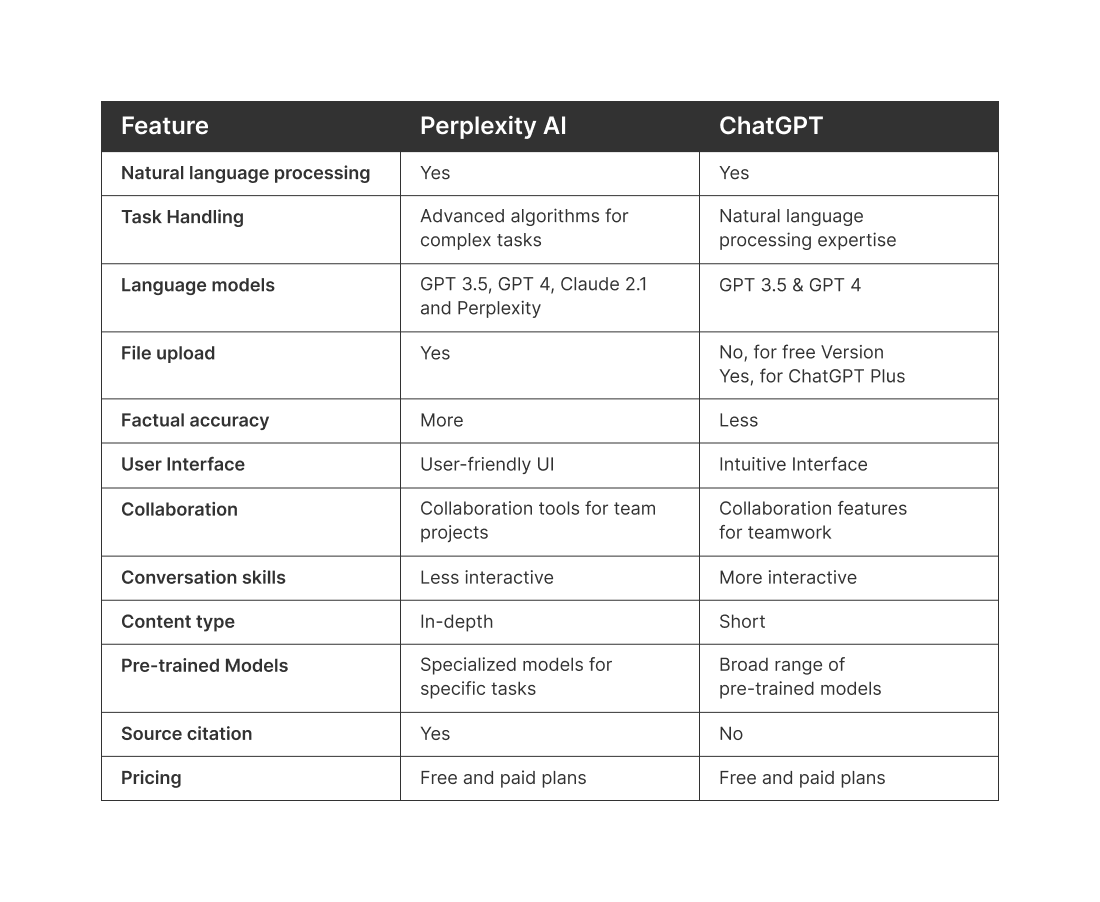
Image source: TextCortex
How Accurate Are They in Real-World Testing?
Accuracy remains the most critical metric for AI users in 2026. Recent benchmarks have highlighted a significant performance gap between the two platforms, particularly in data-sensitive sectors.
In general factual accuracy tests conducted in mid-2026, Perplexity Pro achieved a 92% accuracy rate on real-time queries, while ChatGPT followed at 87%. This gap becomes even more pronounced in specialized fields. For instance, in financial data analysis, Perplexity reached 94% accuracy compared to ChatGPT’s 81%. This is largely attributed to Perplexity’s near-instant indexing of market reports and its source-first architecture, which significantly reduces the "hallucination gap" often found in memory-reliant models.
However, the data shows a notable exception. According to ResultFirst, ChatGPT occasionally outperforms Perplexity in non-English real-time queries, such as specific news events in Spanish. This suggests that while Perplexity is a top-performing tool for English-centric research, ChatGPT’s multilingual reasoning capabilities remain highly competitive.
2026 Accuracy Performance by Sector
- General Facts: Perplexity (92%) vs. ChatGPT (87%)
- Financial Data: Perplexity (94%) vs. ChatGPT (81%)
- Scientific Research: Perplexity (90%) vs. ChatGPT (85%)
- Real-time News: Perplexity (93%) vs. ChatGPT (89%)
Which Model Selection Gives You More Flexibility?
One of the most significant advancements in 2026 is the "Open Ecosystem" approach adopted by Perplexity Pro. Unlike ChatGPT, which is locked into the OpenAI ecosystem (utilizing GPT-5.6 variants like Sol, Terra, and Luna), Perplexity Pro offers a "Model Switcher."
This feature allows users to toggle between the industry's leading models, including GPT-5.6, Claude 4.6, and Gemini 3.1 Pro, depending on the task at hand. For users who require a consensus-based answer, Perplexity Max introduces the "Model Council" strategy. This runs a single query across multiple models simultaneously to synthesize a verified, cross-referenced response. According to Ajelix, this flexibility makes Perplexity a highly versatile tool for power users who don't want to be tied to a single provider's logic.
That said, ChatGPT’s native models are often better optimized for the OpenAI interface. Features like "Advanced Voice Mode" and "Artifacts" (for real-time code previews) function with a level of fluidity that Perplexity’s API-based model integration occasionally struggles to match.
Comparing the New Agentic AI Features of 2026
The "Agentic Frontier" is where the most notable innovation has occurred this year. Both companies have moved beyond simple chat interfaces to autonomous agents that can perform work on your behalf.
Perplexity Computer & Comet
Perplexity has introduced Perplexity Computer and Comet. These agents are designed for autonomous multi-step research. For example, a user can task Comet with "finding the top 10 emerging biotech startups in Scandinavia, scraping their recent funding rounds, and summarizing their core patents." The agent will open multiple tabs, navigate paywalls (where permitted), and compile a comprehensive report without further user intervention.
ChatGPT Atlas
OpenAI’s response is ChatGPT Atlas, a browser-based agent focused on transactional tasks. Atlas is exceptionally strong at navigating internal site UIs to fill out forms, book flights, or manage calendar invites. While Perplexity focuses on the *discovery* of information, Atlas focuses on the *execution* of tasks within the digital environment.
| Feature | Perplexity AI (2026) | ChatGPT (2026) |
|---|---|---|
| Primary Agent | Comet (Research-focused) | Atlas (Action-focused) |
| Accuracy Rate | 92% (General) | 87% (General) |
| Model Choice | GPT, Claude, Gemini, Sonar | GPT-5.6 (Sol/Terra/Luna) |
| Premium Data | Statista, CB Insights, PitchBook | Standard Web Search (Bing) |
| Best For | Analysts, Researchers, Students | Developers, Creatives, Assistants |
Is Perplexity Pro or ChatGPT Plus Better Value for Your Money?
Both Perplexity Pro and ChatGPT Plus maintain a $20/month price point in 2026, but the value proposition has diverged significantly. Choosing the right subscription depends on which "perks" align with your professional needs.
Perplexity Pro Perks: The inclusion of "Premium Sources" is a major draw. Pro users get access to data from paywalled platforms like Statista, CB Insights, and PitchBook, which would otherwise cost thousands of dollars in individual subscriptions. Additionally, Perplexity Pro supports short video generation (up to 8 seconds) and offers unlimited "Pro Search" queries, which use the more advanced reasoning models.
ChatGPT Plus Perks: OpenAI continues to lead in multimodal interaction. ChatGPT Plus includes the full Advanced Voice Mode, which offers near-human latency and emotional inflection. It also features DALL-E 3 integration for high-quality image generation and "Artifacts," a dedicated window for real-time code execution and UI/UX previews. For developers and creative professionals, these features often outweigh the research benefits of Perplexity.
Which Tool Wins for Specific Tasks Like Coding and Writing?
While both tools are highly capable, user consensus and technical benchmarks from G2 suggest clear winners for specific use cases.
Coding and Technical Development
Winner: ChatGPT
ChatGPT remains among the top choices for developers. Its ability to handle complex logic, debug large blocks of code, and provide real-time previews via Artifacts sets a high standard. While Perplexity can find code snippets and documentation effectively, it lacks the deep reasoning required for architectural software design.
Academic and Market Research
Winner: Perplexity AI
Perplexity’s "Pages" feature and inline citations make it a superior tool for students and analysts. The ability to instantly turn a research thread into a formatted report with verifiable links is a significant step forward for academic integrity and professional reporting.
Creative Writing and Nuance
Winner: ChatGPT
When it comes to tone, style, and linguistic nuance, ChatGPT is widely regarded as the more capable model. It is particularly effective at adopting specific personas and maintaining a consistent creative voice over long documents. Perplexity’s output can sometimes feel overly clinical due to its focus on factual retrieval.
How to Use Perplexity and ChatGPT Together for Maximum Productivity
For many power users, the question isn't "which one," but "how to use both." A hybrid workflow leverages the unique strengths of each platform to create a highly impactful output.
Start by using Perplexity’s Pro Search to gather verified facts, statistics from Statista, and market trends from PitchBook. This ensures your foundation is accurate and cited.
Feed the verified data and sources from Perplexity into ChatGPT. Use its reasoning capabilities to draft a creative narrative, build a complex financial model, or generate code based on those facts.
Use the Atlas agent to take the final output and perform an action, such as uploading the report to a CMS, sending it via email to stakeholders, or booking a follow-up meeting.
The Privacy and Data Security Gap
As AI becomes more integrated into corporate workflows, data security has become a primary concern. Perplexity and OpenAI handle user data with different levels of transparency.
Perplexity Pro offers clear data retention policies, allowing users to opt-out of model training easily. However, because it often acts as a gateway to other models (like Claude or Gemini), your data may be subject to the privacy policies of those third-party providers when using the Model Switcher. ChatGPT offers a "Temporary Chat" mode and robust enterprise-grade security for Team and Enterprise users, ensuring that sensitive corporate data is not used to train future iterations of the model. According to user discussions on Reddit, ChatGPT is often perceived as having a more unified security framework for large organizations.
Frequently Asked Questions
For many, the answer is yes, particularly if your work involves heavy research. Perplexity Pro provides access to paywalled data sources like Statista and CB Insights, which ChatGPT cannot access. If you frequently need to verify facts or cite academic sources, the $20/month for Perplexity offers a distinct value proposition that complements ChatGPT’s creative and agentic strengths.
Perplexity is a strong contender to replace traditional search for informational queries. Unlike Google, which provides a list of links, Perplexity provides a direct, synthesized answer with citations. However, for navigational queries (e.g., "log in to my bank") or local searches (e.g., "pizza near me"), traditional search engines or specialized apps still offer a more streamlined experience.
Perplexity AI is widely considered one of the best tools for academic citations. Its source-first architecture ensures that every claim is linked to a specific webpage or document. It also includes a "File Upload" feature that allows students to upload PDFs and ask questions specifically about those documents, ensuring the AI stays within the bounds of the provided text.
Yes, Perplexity Pro users can select GPT-5.6 as their primary reasoning model. One of Perplexity's greatest strengths is its model flexibility, allowing you to use OpenAI's most capable models within the Perplexity interface, alongside alternatives like Claude 4.6 and Gemini 3.1 Pro.
Both tools offer privacy settings to prevent data from being used for training. However, ChatGPT’s "Enterprise" tier is often cited as a top-performing solution for large-scale corporate security. Perplexity is excellent for individual privacy, but users should be aware that using the model switcher involves sending data to different providers (Anthropic, Google, etc.).
Final Thoughts: Choosing Your AI Partner
The competition between Perplexity AI and ChatGPT in 2026 has resulted in two exceptionally strong tools that serve different masters. Your choice should be guided by your daily output requirements.
- Choose Perplexity AI if you are a researcher, analyst, or student who prioritizes factual accuracy (92%) and needs verifiable citations.
- Choose ChatGPT if you are a developer, creative writer, or professional who needs a digital assistant for task execution and multimodal interaction.
- Leverage Model Flexibility: Use Perplexity Pro to access GPT, Claude, and Gemini in one place for diverse perspectives.
- Adopt Agentic Workflows: Use Perplexity Comet for deep research and ChatGPT Atlas for navigating web-based tasks.
- Prioritize Premium Data: Take advantage of Perplexity’s access to Statista and PitchBook for high-level market analysis.
- Maximize Creativity: Rely on ChatGPT for tone, style, and complex coding logic where reasoning is more important than retrieval.
For the most effective results, start your next project by gathering facts in Perplexity and then moving to ChatGPT for synthesis and final execution.