Perplexity AI vs Google Search in 2026 — Which One Should You Actually Use?
As of August 2026, the choice between Perplexity AI and Google Search depends entirely on your intent. Perplexity AI stands out as a top choice for deep research, academic synthesis, and ad-free information gathering. Conversely, Google Search remains a leading option for local utility, real-time shopping, and navigational tasks. While Google maintains a 90% market share, Perplexity has carved out a high-trust niche for professionals who value time-savings over link-browsing.
The search landscape has undergone a significant advancement since the generative AI boom began. In 2026, we no longer view search as a single monolithic activity. Instead, users are bifurcating their habits between "Generative Synthesis"—the act of receiving a structured answer—and "Link-Based Utility"—the act of finding a specific destination or product. This comparison explores how these two giants have evolved to serve these distinct needs.
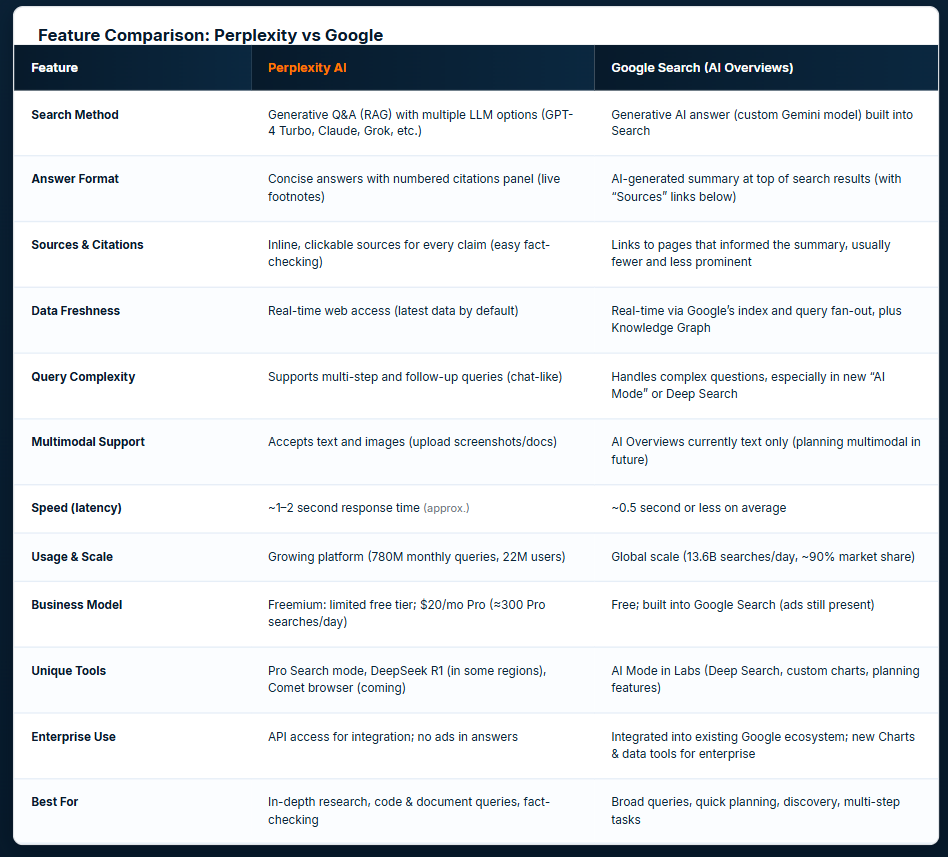
Image source: Index.dev
How Perplexity and Google Compare Across 10 Key Performance Metrics
To understand the current state of search, we must look at the raw data. According to recent industry analysis, the gap in user experience is driven by fundamental architectural differences. Google prioritizes speed and ecosystem breadth, while Perplexity focuses on depth and source transparency.
| Metric | Perplexity AI (2026) | Google Search (2026) |
|---|---|---|
| Core Technology | Multi-LLM Generative Synthesis | Index-Based with AI Overviews |
| Response Speed | 6–10 Seconds (Synthesis) | 0.52 Seconds (Instant) |
| Ad Density | Zero (Ad-Free Pivot Feb 2026) | 25.5% of AI Results contain ads |
| Citation Accuracy | High (Inline Numbered Citations) | Moderate (Source Cards) |
| Local Search | Basic / Aggregated | Superior (Maps Integration) |
| Shopping | Zero-Fee Commerce Model | Ad-Driven Merchant Center |
| Mobile UX | Comet Browser Integration | Google App / Chrome Ecosystem |
| Privacy | Subscription-Based (High) | Data-Tracking (Ad-Supported) |
| Free Tier | Limited Pro Queries | Unlimited with Ads |
| Pro Tier | $20/mo (Advanced Models) | $20/mo (Gemini Advanced) |
The most striking difference remains the speed-to-depth ratio. Google’s 0.52-second response time is exceptionally strong for users who need a quick fact or a weather update. However, for complex queries that would typically require opening 10+ tabs, Perplexity’s 10-second synthesis is widely regarded as a more efficient workflow, often saving professionals 2–3 hours per week on research tasks.
Why Perplexity AI Abandoned Ads While Google Doubled Down
A major turning point in the search wars occurred in February 2026. After experimenting with sponsored follow-up questions, Perplexity formally abandoned the advertising model. This pivot was a significant step forward in establishing user trust, positioning the platform as a "clean" research environment. By focusing on a high-value subscription model, Perplexity avoids the conflict of interest inherent in recommending products that have paid for visibility.
Google, conversely, has faced challenges balancing its AI transition with its core business model. As generative answers satisfy more queries directly on the search results page, organic click-through rates (CTR) have seen a 61% drop. To compensate, Google has integrated ads more deeply into the AI experience. For many users, this has created a "sponsored synthesis" environment where it is increasingly difficult to distinguish between objective information and paid promotion.
Which Search Engine Wins for Your Specific Daily Tasks?
In 2026, the "best" tool is no longer a single choice but a strategic selection based on the task at hand. Most power users now employ a hybrid approach, using Google for navigation and Perplexity for investigation.
Why Google Still Dominates Local Search and Shopping
Google’s infrastructure for local data remains remarkably robust. If you are searching for a "coffee shop open now" or "mechanic near me," Google’s integration with Google Maps and real-time business profiles provides a level of utility that Perplexity cannot currently match. Google’s ability to pull from billions of real-time data points—including traffic, store occupancy, and live inventory—makes it a top-rated choice for "in-the-moment" needs.
In the shopping sector, Google’s Merchant Center integration allows users to compare prices across thousands of retailers instantly. While Perplexity has introduced a "Zero-Fee Commerce" model that allows for direct purchasing within the interface, it lacks the sheer volume of local and global inventory that Google has indexed over decades.
Why Perplexity Is the Superior Tool for Complex Research and Coding
For tasks that require synthesizing information from multiple sources, Perplexity ranks among the top options available. Its "Focus Mode" is a notably innovative feature that allows users to restrict searches to specific domains like Reddit, Academic Papers, or YouTube. This effectively filters out the SEO-optimized "junk" that often clutters the top of Google’s search results.
Developers also find Perplexity to be a highly impactful tool for debugging and code generation. By synthesizing documentation from GitHub, Stack Overflow, and official API references into a single coherent explanation, it eliminates the need to hunt through disparate forum threads. According to user surveys from mid-2026, Perplexity is often preferred over Google Gemini for technical troubleshooting due to its superior source attribution.
The Battle of Citations and Fact-Checking
One of the primary frustrations with generative AI is the risk of hallucination. Perplexity addresses this by making citations the centerpiece of the experience. Every claim is backed by a numbered footnote that links directly to the source. This transparency allows users to verify information in seconds.
Google has attempted to match this with "Source Cards" in its AI Overviews, but the implementation is often criticized for being less granular. While Google is faster, Perplexity’s synthesis is widely considered more reliable for high-stakes research. However, it is important to note that Perplexity is not immune to errors; users have reported instances where the AI cites mismatched sources or fails when web results are thin. As noted by tech analyst Konabayev, citation quality can vary depending on the complexity of the topic.
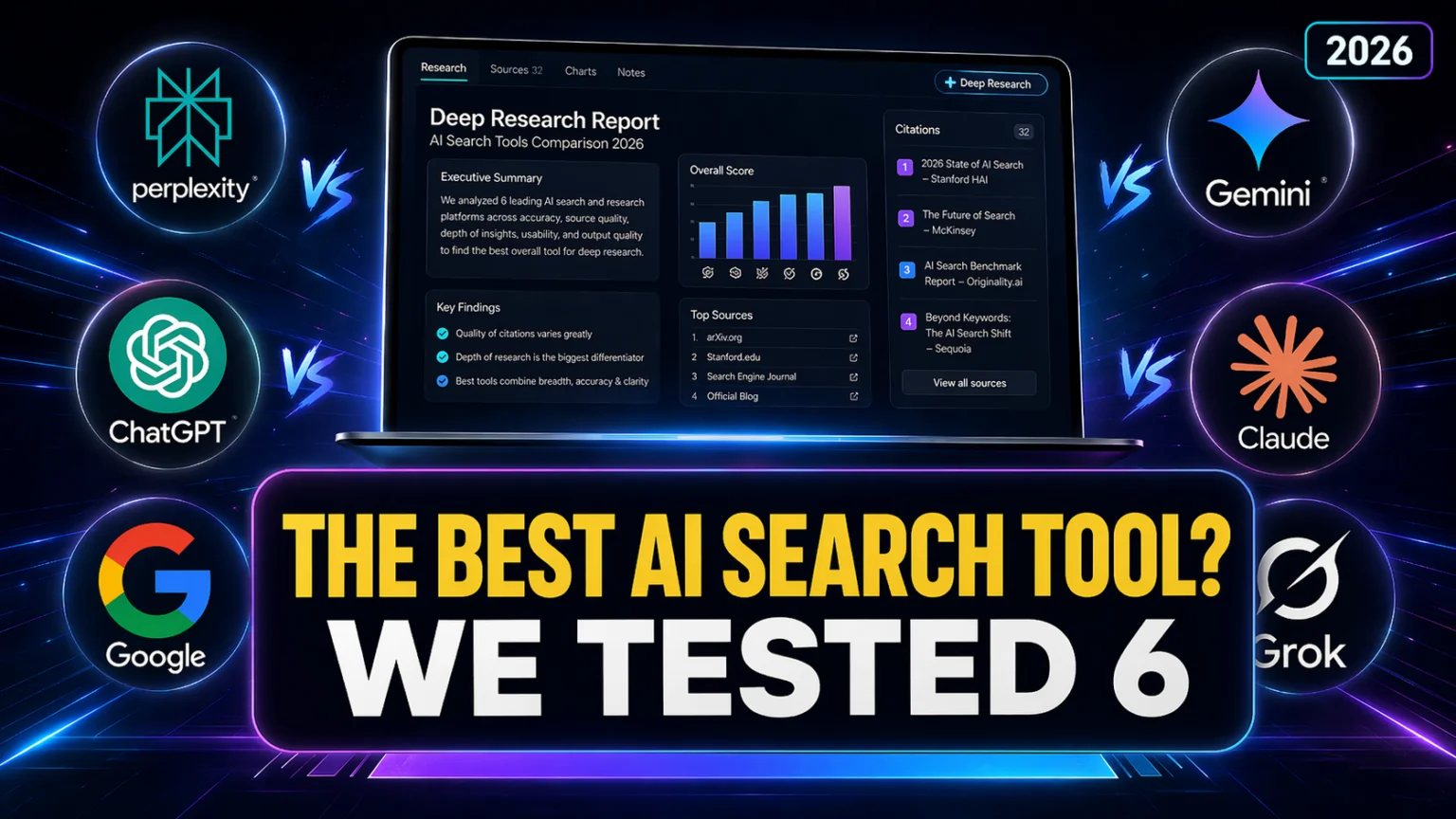
Image source: Fello AI
The Real Cost of AI Search for Publishers and Marketers
The shift toward AI-driven answers has had a profound impact on the open web. When a search engine provides a complete answer, the user has no reason to click through to the original publisher. This "zero-click" trend has reached new heights in 2026.
- CTR Collapse: Organic click-through rates have dropped by an estimated 61% for informational queries.
- Publisher Impact: Major sites like HubSpot and Business Insider have reported traffic declines ranging from 55% to 70% for top-of-funnel content.
- Quality Over Quantity: While traffic volume is down, the quality of referral traffic from Perplexity is significantly higher, with conversion rates reaching 10.5%.
For marketers, this requires a shift in strategy. Success in 2026 is less about ranking #1 for a keyword and more about being the "cited source" within an AI synthesis. Brands that provide unique, data-driven insights are more likely to be referenced by Perplexity’s engine, leading to high-intent traffic that actually converts.
Advanced Workflows and Ecosystem Integration in 2026
The battle for search dominance is also being fought at the browser and OS level. Perplexity’s integration with the Comet Browser has introduced a new search-to-action workflow. Users can highlight text on any webpage and instantly trigger a Perplexity synthesis without leaving the tab. This seamless integration is a major improvement over the traditional "copy-paste-search" method.
- Enter query in search bar.
- Scan 10 blue links.
- Open 5 tabs in background.
- Read and synthesize manually.
- Total Time: ~15–20 minutes.
- Enter query in Comet bar.
- Read synthesized answer.
- Verify via inline citations.
- Ask follow-up for nuance.
- Total Time: ~3–5 minutes.
Furthermore, Perplexity’s ability to handle file-based research—such as auditing a 100-page PDF or analyzing a complex spreadsheet—gives it a competitive edge for professional use cases. While Google Search handles basic file types, Perplexity’s native "File Upload" feature allows for a much deeper level of interaction with private data, making it a top-tier choice for students and analysts alike.
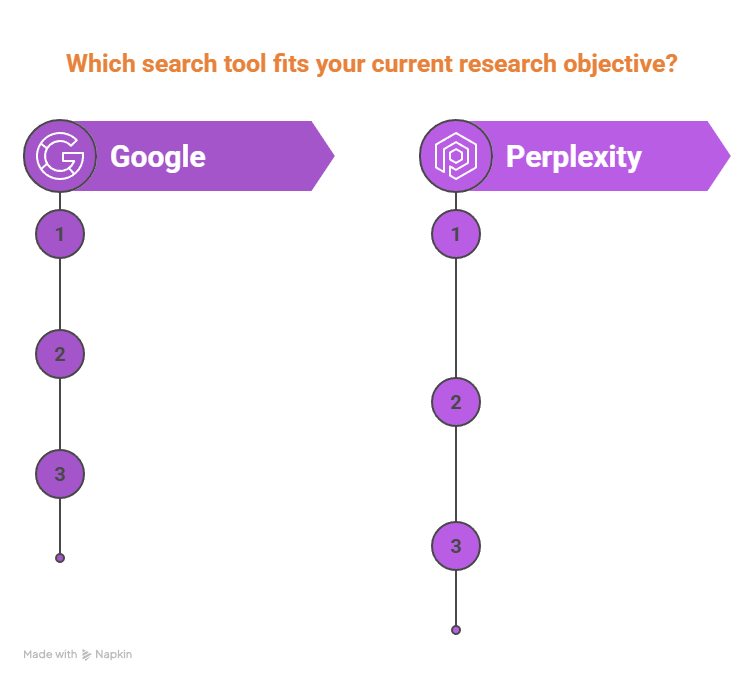
Image source: SoloScaleTools: AI Tools for Solo Founders
Is Perplexity Pro Worth the $20 Monthly Fee?
Both platforms offer premium tiers at the $20/month price point. Perplexity Pro provides access to a variety of top-performing models (including the latest from OpenAI and Anthropic), unlimited file uploads, and a higher daily limit for "Pro" queries that use more intensive reasoning. For a professional researcher or a student, this fee is often justified by the hours of manual work it replaces.
Google One / Gemini Advanced, on the other hand, offers a more holistic ecosystem value. The subscription includes 2TB of cloud storage and deep integration with Google Workspace (Docs, Gmail, Sheets). If your primary need is an AI assistant that can help you write emails and manage your calendar, Google’s offering is a strong contender. However, if your priority is the most accurate and transparent search experience, Perplexity Pro remains the preferred choice for many power users.
Frequently Asked Questions
Key Takeaways: The Bottom Line
- Google is for doing: Use it for local navigation, shopping, and quick factual lookups where speed is paramount.
- Perplexity is for learning: Use it for deep research, technical troubleshooting, and synthesizing complex topics without ads.
- Ad-Free Advantage: Perplexity’s February 2026 pivot away from ads makes it a high-trust environment for objective information.
- Conversion Disparity: Referral traffic from Perplexity converts at 10.5%, nearly 6x the rate of Google’s organic search.
- Workflow Efficiency: Perplexity can save professional users up to 3 hours per week by eliminating the "multi-tab" research method.
- Local Dominance: Google’s 90% market share is sustained by its exceptionally strong local data and ecosystem integration.
Final Recommendation: Start your research in Perplexity to build a foundation, then switch to Google for the final "action" steps like booking or buying.