As of August 2026, the OpenRouter landscape is dominated by DeepSeek V4 Flash, which handles over 619 billion tokens daily. Chinese AI labs now command approximately 46.4% of the total platform volume, which has reached a staggering 29.2 trillion tokens per week. While usage rankings highlight high-throughput models like DeepSeek and Mimo V2.5, production reliability and complex tool-calling tasks still drive significant traffic to premium providers like Anthropic, despite their higher costs.
Understanding the 2026 OpenRouter Market Landscape
The AI infrastructure market has undergone a massive transformation in recent years. OpenRouter, serving as the primary aggregator for over 400 models, provides a transparent window into which Large Language Models (LLMs) are actually being deployed in production environments. By August 2026, the platform's total weekly volume has surged to 29.2 trillion tokens, reflecting the deep integration of AI into global software ecosystems.
One of the most notable shifts is the rise of high-throughput, low-latency models that prioritize cost efficiency. The OpenRouter rankings reveal that developers are increasingly moving away from "generalist" models toward specialized infrastructure. This shift is driven by the need for scalable solutions in autonomous agents, coding assistants, and high-volume data processing.
Chinese Labs
Labs like DeepSeek, Xiaomi, and MiniMax now control 46.4% of the token volume, leveraging aggressive pricing and high performance.
29.2T Tokens
Total weekly platform volume as of June 2026, indicating a massive scale-up in API-driven AI applications.
Developers choose OpenRouter not just for the variety of models, but for the robust infrastructure features it provides. Features such as billing caps, unified API keys, and provider-specific caching hit rates have made it a top choice for startups and independent developers who need to manage costs while maintaining access to the latest advancements in AI.
Why DeepSeek V4 Flash Currently Dominates the Token Volume
DeepSeek V4 Flash has emerged as a powerhouse in the 2026 rankings, consistently holding the #1 spot by daily token volume. With 619 billion tokens processed every 24 hours, it has become the "default" choice for many high-volume applications. The reason for this dominance is a combination of aggressive pricing and a "full-stack" provider strategy.
Pricing Efficiency and Developer Adoption
At approximately $0.084 per million input tokens, DeepSeek V4 Flash offers a price-to-performance ratio that few competitors match. This pricing makes it feasible to run massive batch processing jobs or maintain persistent autonomous agents that would be cost-prohibitive on more expensive models. According to coding collection data, this efficiency is particularly valued in the programming community, where large context windows and frequent iterations are required.
The Full-Stack Provider Strategy
DeepSeek's success is also attributed to its ability to prevent vendor switching. By offering a range of models—from the high-throughput Flash to the reasoning-focused Pro and various legacy versions—they cater to the entire lifecycle of an application. A developer might prototype with Pro and then scale the production environment using Flash, all within the same ecosystem. This strategy has allowed DeepSeek to capture a 17.6% weekly market share, surpassing even established giants like Anthropic in raw volume.
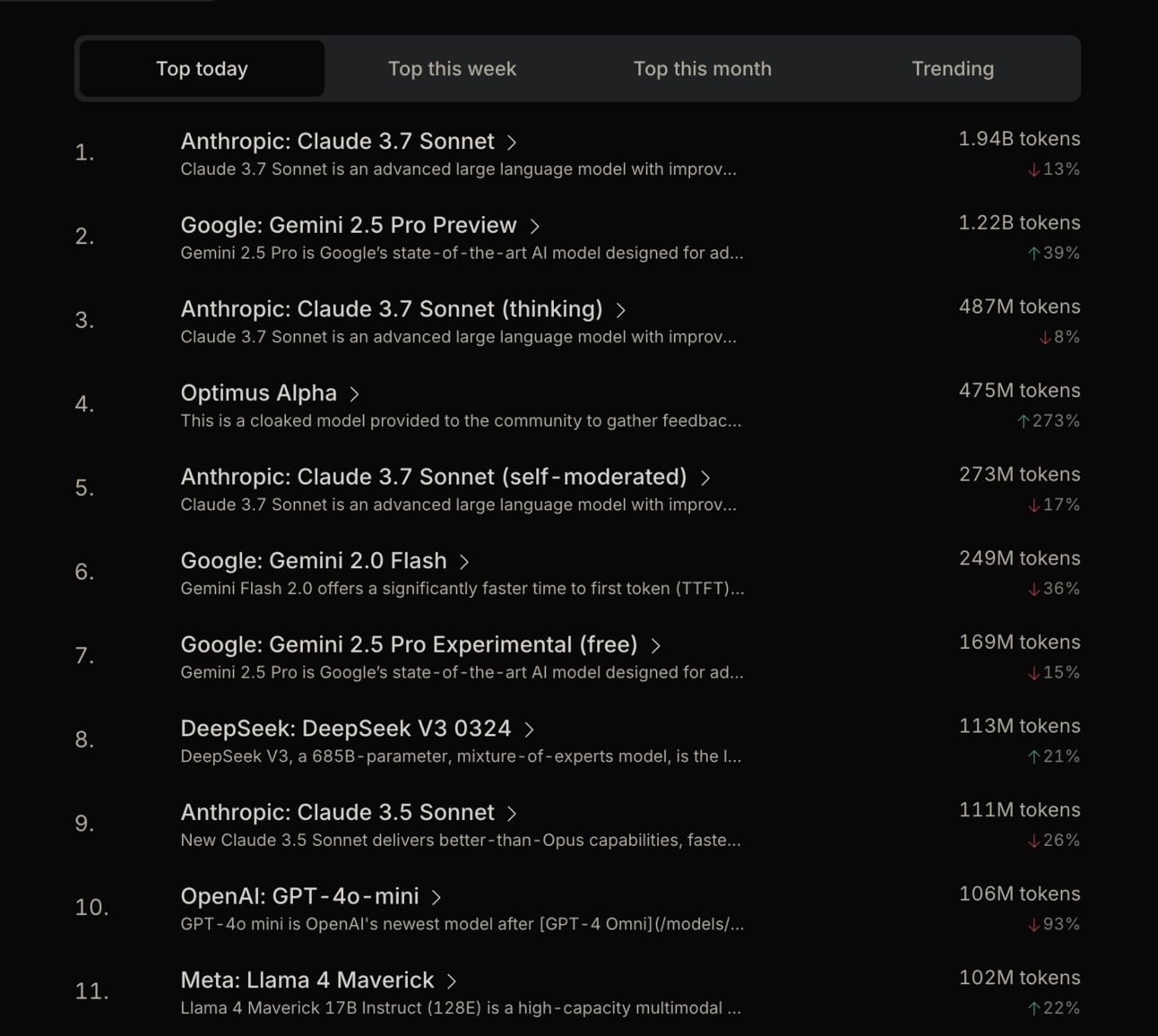
Image source: Startup Spells 🪄
The Whale Skew and Why Usage Does Not Always Mean Quality
While token volume is a powerful metric, it can be misleading. The "Whale Skew" refers to a phenomenon where a single massive enterprise user or a popular open-source tool can significantly inflate a model's ranking. This means that a model sitting at the top of the list might not necessarily be the "smartest" or most reliable for general-purpose tasks; it might simply be the most cost-effective for a specific, high-volume use case.
Identifying Artificial Volume Inflation
Discussions on Hacker News have pointed out that tools like OpenClaw or specific autonomous agent frameworks often default to a single model. If that tool gains viral popularity, the model's token volume will skyrocket regardless of its performance in other areas. For instance, MiniMax M3 (batch) became a top-ranked model largely due to its adoption by autonomous agent developers who prioritize batch processing speeds over nuanced reasoning.
Popularity vs. Production Reliability
For professional developers, the "Claude Tax" is a real consideration. Anthropic maintains a 14.8% market share despite being significantly more expensive than DeepSeek. This is because models like Claude 4.7 Opus are widely regarded as one of the top choices for complex tool-usage and long-context reliability. In production environments where a single hallucination can be costly, developers are often willing to pay a premium for the stability that high-volume, low-cost models may lack.
How to Use Caching Hit Rates to Lower Your API Costs
One of the most overlooked metrics in the OpenRouter rankings is the caching hit rate. As prompt caching becomes a standard feature, the ability of a provider to reuse previously processed context can lead to a 50% reduction in input costs. However, these hit rates vary significantly between different providers hosting the same model.
The Hidden Economics of Prompt Caching
When you send a large prompt (such as a codebase or a long document), the provider can "cache" that data. If your next request includes the same prefix, you only pay a fraction of the cost for that portion. Technical insights from Hacker News discussions reveal that Anthropic Opus 4.7 can achieve hit rates as high as 90% on certain providers, while older versions or different providers might struggle to hit 45%.
| Model Provider | Avg. Caching Hit Rate | Potential Cost Savings |
|---|---|---|
| Anthropic (Direct/High-Tier) | 85% - 92% | Up to 50% |
| DeepSeek (Official) | 70% - 80% | Up to 35% |
| Third-Party Aggregators | 30% - 50% | Minimal |
Provider Variance and Dynamic Switching
OpenRouter publishes hourly caching states for various providers. Savvy developers use this data to switch providers dynamically. If one provider's cache is saturated or underperforming, routing traffic to a different provider for the same model can result in immediate savings. This level of granular control is a significant advancement for managing large-scale AI deployments.
Which Models Perform Best for Coding and Autonomous Agents?
Coding remains the primary driver of high-value token traffic on OpenRouter. The 2026 coding leaderboard shows a fascinating competition between established US labs and innovative Chinese providers. While DeepSeek is a strong contender, other models like Mimo V2.5 (Xiaomi) and GLM 5.2 (Z.ai) have carved out significant niches.
The 2026 Coding Leaderboard Analysis
Mimo V2.5 currently leads the programming category with a 19.1% share of coding-related tokens. Its success is built on its ability to handle massive repositories and provide highly accurate code completions. DeepSeek V4 Flash follows closely with 11.5%, favored for its speed in real-time IDE integrations. These models are often preferred over GPT-5.6 or Claude for repetitive coding tasks due to their lower latency and specialized training sets.
Agentic Preferences and Tool-Usage Reliability
For autonomous agents—systems that can browse the web, use APIs, and execute code—the requirements are different. Reliability in tool-calling is paramount. This is where models like Claude Code and Hermes Agent drive significant traffic. According to app ranking data, MiniMax M3 has become a favorite for agents like OpenClaw because it balances reasoning depth with the throughput needed for multi-step agentic workflows.
Why Anthropic and OpenAI Have Lower Rankings Than You Expect
It may be surprising to see OpenAI with only an 8.4% share on OpenRouter, given its global dominance. However, this is largely due to the "Proxy Tax." Large enterprises typically use OpenAI directly via Azure or the official OpenAI API to maintain strict compliance and avoid third-party aggregators. OpenRouter's rankings are more reflective of the independent developer, startup, and open-source communities.
The Proxy Tax and Enterprise Direct Usage
For a Fortune 500 company, the overhead of using an aggregator might not be worth the flexibility. They prioritize direct support and established legal frameworks. Consequently, the OpenRouter rankings are skewed toward "Value Kings"—models that offer the most bang for the buck for users who are paying out of pocket or working with limited venture capital.
The Grok Paradox in Production
Another interesting case is Grok. While it often ranks high on synthetic benchmarks like ArtificialAnalysis, its production usage on OpenRouter remains relatively low. Community feedback suggests that while Grok is powerful, its tool-calling capabilities and API stability have historically lagged behind Claude and GPT, making it a less popular choice for production-grade autonomous systems.
Are Free Models on OpenRouter Safe for Professional Use?
OpenRouter offers a variety of free models, such as Nemotron 3 Ultra and Laguna S 2.1. While these are excellent for testing and hobbyist projects, professional users should exercise caution. The community on platforms like Reddit has frequently discussed the privacy trade-offs associated with "free" AI services.
The Privacy Trade-off in Free Tiers
In the AI world, if you aren't paying for the product, your data might be the product. Many free models are offered as a way for labs to gather real-world usage data to refine their next generation of models. For DevOps environments, this poses a significant security risk. Professional-grade applications should always utilize paid endpoints that offer explicit data opt-out policies.
Best Practices for DevOps Security
When integrating OpenRouter into a production pipeline, managing API keys and billing caps is essential. OpenRouter’s billing system allows you to set hard limits, preventing "million-dollar overnight" accidents caused by runaway recursive loops in autonomous agents. This infrastructure reliability is one of the primary reasons developers stick with the platform despite the availability of direct APIs.
How to Choose the Right Model Based on Your Specific Budget
Navigating the hundreds of models on OpenRouter requires a structured approach. Instead of just picking the #1 model, follow this decision framework to find the best fit for your specific needs.
- Determine Your Primary Need: Do you need "Reasoning" (complex logic, few errors) or "Throughput" (fast, cheap, high volume)? If you need reasoning, look at Claude 4.7 or DeepSeek Pro. For throughput, DeepSeek Flash or Mimo V2.5 are top choices.
- Check the Caching Hit Rate: Before committing to a model, look at the provider-specific caching hit rates. A slightly more expensive model with a 90% hit rate can end up being cheaper than a "budget" model with no caching support.
- Evaluate the "Claude Tax": Ask yourself if the task requires high-reliability tool-usage. If the model needs to interact with external databases or execute code, the reliability of Anthropic models is often worth the 2x price increase over cheaper alternatives.
Frequently Asked Questions
- How are OpenRouter rankings calculated?
- OpenRouter rankings are primarily based on token volume—the total number of input and output tokens processed by a model over a specific period (daily or weekly). While this is a great indicator of popularity and cost-efficiency, it can be influenced by "whale" users or popular open-source tools that default to a specific model. It does not necessarily reflect the qualitative "intelligence" of a model for every use case.
- What is the cheapest high-performing LLM on OpenRouter right now?
- As of August 2026, DeepSeek V4 Flash stands out as a top choice for those seeking high performance at a low cost. With input pricing around $0.084 per million tokens and a massive context window, it offers a level of efficiency that few other models can match. It is particularly popular for high-volume tasks like log analysis, basic code completion, and large-scale data transformation.
- Why is OpenAI ranked lower than DeepSeek on this platform?
- OpenAI's lower ranking on OpenRouter (around 8.4% share) is not a reflection of its global popularity but rather how it is accessed. Most large enterprises use OpenAI directly through Azure or the official OpenAI API to ensure compliance and direct support. OpenRouter's data is more representative of developers and startups who value the ability to switch between 400+ models through a single interface.
- Which OpenRouter model is best for coding in 2026?
- For professional coding tasks, Mimo V2.5 and DeepSeek V4 are currently the top-performing options based on usage data. Mimo V2.5 is highly regarded for its repository-level understanding, while DeepSeek V4 Flash is favored for its speed and cost-effectiveness in IDE extensions. However, for complex architectural decisions, many developers still prefer Claude 4.7 Opus due to its superior reasoning capabilities.
- Does OpenRouter usage data include free models?
- Yes, the rankings include free models. However, users should be aware that free models often come with different privacy terms. Community discussions suggest that data sent to free models is more likely to be used for training purposes. For professional or sensitive applications, it is widely considered one of the best practices to use paid tiers to ensure better data security and privacy.
- How do I prevent billing surprises on OpenRouter?
- OpenRouter provides robust billing tools, including the ability to set hard billing caps and credit-based systems. This is a critical feature for developers working with autonomous agents, which can occasionally enter recursive loops and consume millions of tokens in a short period. By setting a cap, you ensure that your costs never exceed your budget, regardless of model behavior.
The Bottom Line
The 2026 OpenRouter rankings reveal a market that has matured beyond simple benchmark chasing. Today's developers prioritize a mix of throughput, caching efficiency, and specialized performance.
- Don't trust rankings blindly; always check if a model's volume is driven by a single "whale" or tool.
- Prioritize caching hit rates to potentially save up to 50% on your monthly API bill.
- DeepSeek V4 Flash is the current leader for high-volume, cost-sensitive applications.
- Claude remains a top-tier choice for complex tool-calling and agentic workflows despite the higher cost.
- Chinese AI labs now represent nearly half of the platform's token volume, signaling a major shift in the global AI economy.
- Set billing caps immediately to protect your infrastructure from runaway costs.
To get started, evaluate your specific throughput needs and test your most frequent prompts against the top three models in your category to find the most efficient balance of cost and quality.