As we move deeper into 2026, the way we interact with artificial intelligence has fundamentally changed. We are no longer just "chatting" with LLMs; we are deploying agents that live in our terminals, manage our git repositories, and execute complex scientific simulations. Anthropic has responded to this shift by evolving its subscription model from simple message limits to a sophisticated "rolling compute budget."
Whether you are a student looking for a study aid or a software engineer needing a 24/7 autonomous coding partner, understanding the nuances of each anthropic plan is essential to maximizing your productivity without overspending. This guide breaks down the current pricing structures, technical features, and optimization strategies to help you choose the right tier for your workflow.
What Are the Different Anthropic Claude Plans Available?
Anthropic currently offers a tiered ecosystem that separates individual users from collaborative teams and large-scale enterprises. The primary differentiator in 2026 is no longer just model access—since almost all tiers provide access to the flagship Opus 5 and Sonnet 5 models—but rather the compute capacity and agentic tools included.
| Tier Name | Monthly Cost | Key Feature | Best For |
|---|---|---|---|
| Free | $0 | Sonnet 5 & Artifacts | Casual exploration |
| Pro | $20 ($17 annual) | Claude Code & 5x Usage | Daily professionals |
| Max 5x | $100 | 25x Free Capacity | Power users |
| Max 20x | $200 | 100x Free Capacity | Full-time AI agents |
| Team Standard | $25 / seat | SSO & Admin Tools | Small startups |
| Enterprise | Custom ($20 base) | HIPAA & Audit Logs | Regulated industries |
The Core Model Lineup for 2026
To understand the value of these plans, one must look at the models powering them. According to Anthropic’s latest model releases, the ecosystem is currently led by four distinct engines:
- Opus 5: The flagship model designed for deep reasoning, complex architectural coding, and nuanced creative writing.
- Sonnet 5: The workhorse model, optimized for speed and agentic tasks. It is the default for most Claude Code sessions.
- Haiku 4.5: A fast, low-cost model used primarily for simple automation and high-volume data processing.
- Fable 5: A specialized high-end model available primarily via API, designed for tasks requiring near-human level precision in logic.
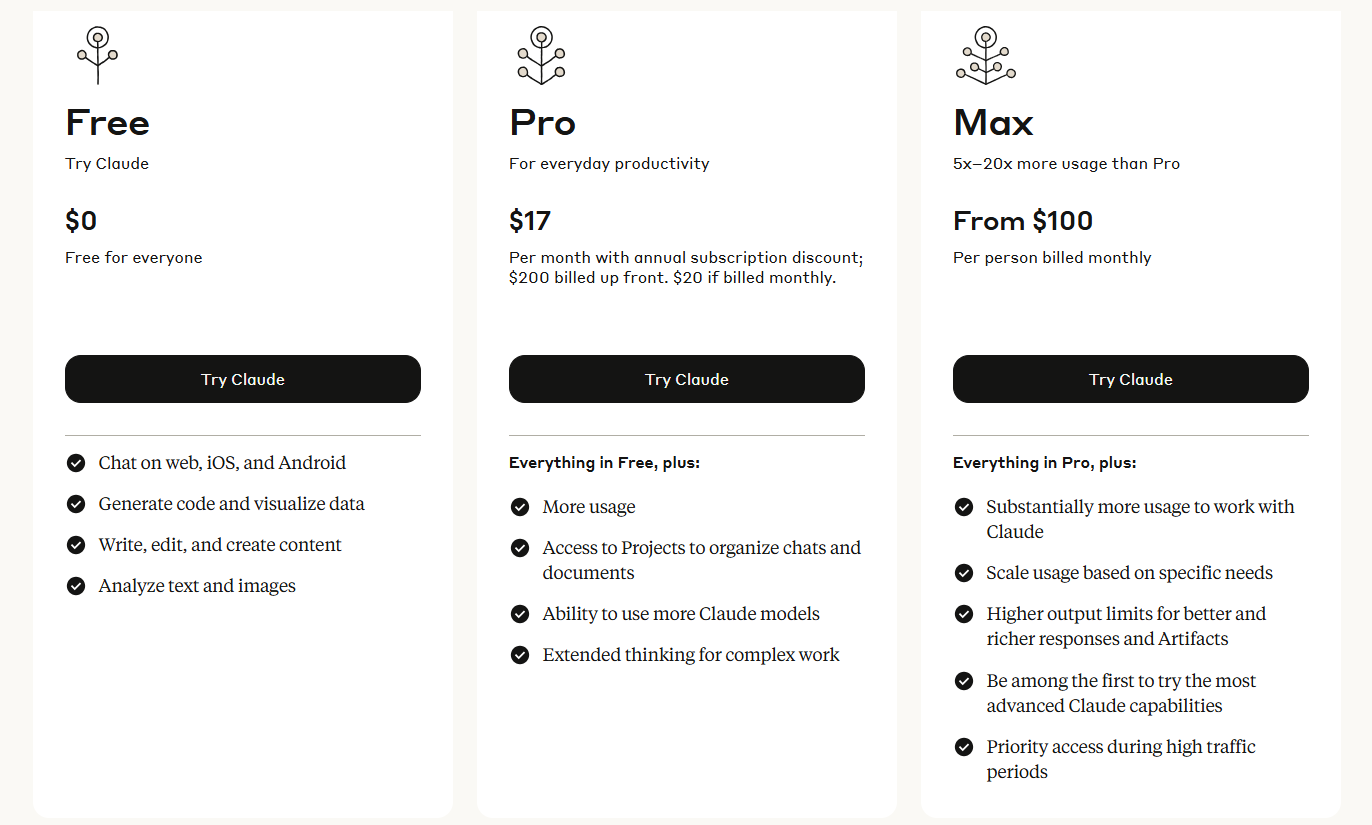
Image source: Medium
Breaking Down the Individual Subscription Tiers
For individual users, the choice usually comes down to how many hours a day they intend to work alongside Claude. The "rolling budget" system means that usage is calculated based on the total tokens (words and code) processed over a sliding window, rather than a hard daily message count.
Is the $20 Claude Pro Plan Still a Top Value Choice?
The $20/month Claude Pro plan remains a popular choice for the majority of users. In recent months, Anthropic introduced an annual billing option that brings the cost down to $17/month, making it highly competitive with other market offerings. According to the Anthropic Help Center, Pro users receive five times the usage capacity of the Free tier.
Crucially, the Pro plan now includes Claude Code, a terminal-based agent that can read your local files, run tests, and submit git commits. For a developer, this inclusion alone justifies the cost, as it transforms the LLM from a simple chatbot into a functional pair programmer. However, users should note that high-intensity coding sessions—especially those involving large repositories—can still hit the Pro limits within a few hours of continuous work.
Why Users Are Choosing the $100 or $200 Max Tiers
The jump from $20 to $100 or $200 can seem steep, but it addresses a specific pain point: the "Agent Era" usage gap. When using Claude Code in "agentic mode," the model often performs dozens of background tasks—searching files, checking documentation, and linting code—each of which consumes tokens from your budget.
The Max 20x plan ($200/mo) provides 20 times the capacity of the Pro plan, which equates to roughly 100 times the capacity of a Free user. This tier is designed for professionals who use AI agents as their primary interface for 8+ hours a day. It effectively removes the anxiety of "running out of messages" during a critical debugging session. As noted in recent pricing analyses, the Max tiers are cumulative, meaning they scale your capacity across all Claude apps, including Claude Cowork and Claude Science.
Anthropic Plans for Teams and Enterprise Organizations
For businesses, the focus shifts from individual usage to security, administrative control, and shared context. Anthropic’s team plans are designed to allow groups to build "Project Knowledge," where the AI is trained on the specific documentation and style guides of the company.
Comparing Team Standard and Team Premium Features
The Team Standard plan ($25 per seat, or $20 billed annually) is the baseline for collaborative work. It includes everything in the Pro plan plus administrative tools like Single Sign-On (SSO) and the ability to manage user roles. The primary benefit here is the "Projects" feature, which allows teams to upload shared datasets that all members can reference in their chats.
The Team Premium plan ($125 per seat) is a newer addition for 2026. It bridges the gap for high-intensity departments—like engineering or data science teams—that require the 5x usage multiplier of the Max tiers but need the centralized billing and security of a team account. This plan ensures that a company's most active AI users aren't throttled during peak development cycles.
Image source: Search Engine Journal
When Your Organization Requires the Enterprise Plan
For organizations in regulated industries such as healthcare, finance, or law, the Enterprise plan is often the only viable option. This tier provides critical compliance features, including HIPAA and SOC2 Type II support. It also introduces SCIM (System for Cross-domain Identity Management) for automated user provisioning and detailed audit logs for security monitoring.
The pricing for Enterprise is typically a base fee (around $20 per seat) plus usage-based scaling. This allows large corporations to pay only for the compute they actually consume, which can be more cost-effective than flat-rate subscriptions for thousands of employees who may have varying levels of AI engagement.
Claude Code and the New Agent Era Features
One of the most significant advancements in the 2026 Anthropic ecosystem is the integration of Claude Code into the standard subscription plans. Claude Code is not just another chat window; it is a CLI (Command Line Interface) tool that operates directly on your machine.
Key capabilities of Claude Code include:
- Parallel Execution: Using git worktrees, Claude Code can work on 3–5 different pull requests or features simultaneously. While one session is running a long test suite, you can switch to another worktree and have Claude start a new task.
- Autonomous Debugging: You can give a command like
claude "fix the bug in the auth flow and run the tests", and the agent will navigate the codebase, identify the error, apply a fix, and verify it without further input. - Batch Migrations: The
/batchcommand allows for large-scale refactoring across hundreds of files, a task that would be impossible in a standard web-based chat interface.
Subscription vs API — Which One Saves You More Money?
A common question among developers is whether they should stick to a subscription or use the pay-as-you-go API. The answer depends entirely on your token consumption patterns. As of late 2026, the Fable 5 API rates are approximately $50 per million output tokens.
If you are a heavy user of Claude Code, you might process 5 million output tokens in a month. On the API, this would cost you $250. In this scenario, the $200 Max 20x plan is clearly the more economical choice, as it provides a higher effective ceiling for a lower flat fee. However, for casual developers who only use the API for occasional scripts, the pay-as-you-go model remains a top-tier option for cost control.
ANTHROPIC_API_KEY environment variable set in your terminal, Claude Code will default to billing your API account instead of using your subscription credits. Always check your .zshrc or .bashrc files to ensure you aren't being double-billed.
How to Optimize Your Usage and Avoid Hidden Costs
Regardless of which anthropic plan you choose, managing your "token burn" is the key to getting the most value. In the Agent Era, context is expensive, and repetitive instructions can quickly deplete your rolling budget.
Mastering the Effort Command for Token Control
In Claude Code, you can use the /effort command to tell the model how much "thinking" it should do. According to Anthropic's power user documentation, there are three primary settings:
- Low: Best for simple file edits or explanations. It uses fewer tokens and responds faster.
- Medium: The default setting for standard coding tasks.
- Max: Forces the model to use "Extended Thinking" for complex architectural changes. This is token-heavy but reduces the need for multiple follow-up corrections.
Reducing Context Overhead by 85 Percent
One of the biggest "hidden costs" in AI agents is the loading of tools (like GitHub, Slack, or Jira integrations). Traditionally, loading these tools could consume over 70,000 tokens before you even sent your first message. Anthropic's Tool Search Tool has significantly improved this efficiency.
By discovering and loading tools only when they are needed, the initial context overhead has been reduced from ~72,000 tokens to just ~8,700 tokens—an 85% reduction. Users on the Pro plan should ensure they are using the latest version of Claude Code to take advantage of this optimization, which effectively stretches their usage budget much further.
Building Micro-Skills with CLAUDE.md
To avoid repeating yourself, you can create a CLAUDE.md file in the root of your project. This acts as a "persistent memory" for the model. Instead of including 2,000 tokens of instructions in every prompt about your coding style or project structure, Claude reads this file once at the start of the session. This "micro-skill" architecture is widely regarded as one of the most effective ways to maintain consistency while saving on token costs.
Frequently Asked Questions
- Is there a free version of Anthropic Claude?
- Yes, Anthropic offers a Free tier that includes access to the Sonnet 5 model, web search capabilities, and the Artifacts UI. While it has the lowest usage limits, it is a strong choice for casual users who need occasional assistance with writing or analysis.
- Does Claude Pro have a fixed message limit?
- No, Claude Pro uses a "rolling context budget" rather than a fixed number of messages. Your limit depends on the length of your conversations and the complexity of the tasks. If you use "Extended Thinking" or upload large files, you will reach your limit faster than if you engage in short, text-only chats.
- Are there student discounts for Claude?
- Anthropic provides academic rates for verified university members, typically offering a discount on the annual Pro plan. Students should check the official pricing page while logged in with a .edu email address to see current offers.
- Can I use Claude for HIPAA-compliant work?
- HIPAA compliance is exclusively available on the Enterprise plan. Individual Pro or Max plans do not meet the regulatory requirements for handling Protected Health Information (PHI), and users in the medical field should upgrade to Enterprise for these use cases.
- What is the difference between Max 5x and Max 20x?
- The Max 5x plan ($100/mo) provides five times the capacity of a Pro subscription. The Max 20x plan ($200/mo) provides twenty times the Pro capacity. The latter is specifically designed for users running multiple parallel agentic sessions in Claude Code throughout the workday.
Key Takeaways for Choosing Your Plan
- Assess your session duration: If you use AI for more than 4 hours a day, the Max tiers offer better stability than the Pro plan.
- Leverage annual billing: Switching to annual billing for the Pro plan saves you $36 per year, bringing the monthly cost to $17.
- Monitor your environment: Ensure your
ANTHROPIC_API_KEYisn't causing unexpected charges if you already pay for a subscription. - Use the /effort command: Throttling the model's reasoning level can extend your daily usage budget by up to 40%.
- Implement CLAUDE.md: Use persistent memory files to reduce repetitive token burn in your coding projects.
- Choose Enterprise for compliance: Do not handle sensitive data (HIPAA/SCIM) on individual plans; the Enterprise tier is required for legal safety.
Start by evaluating your average daily token consumption in the Claude dashboard to determine if your current plan meets your productivity needs.